

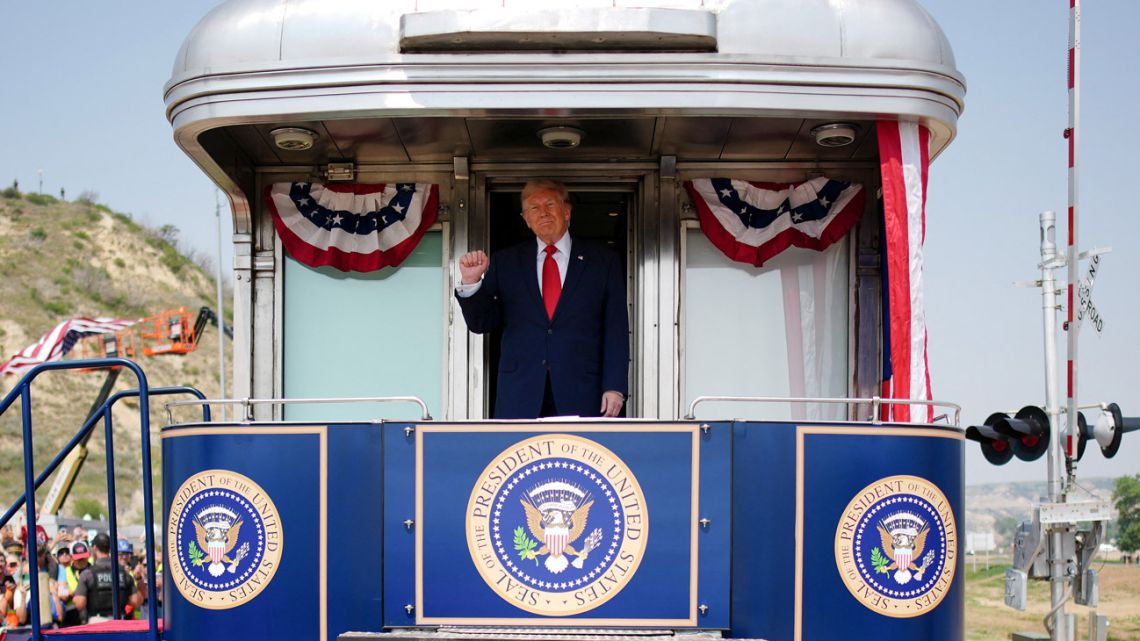
A wealthier and more diverse nation, but also a more divided one – the United States celebrates its 250th anniversary on July 4 amid stark contrasts, despite the triumphalist message of its current President, Donald Trump.
"As the nation approaches its 250th anniversary, the mood among the American public is sombre, albeit with some signs of enduring optimism," said the Pew Center think tank in a recent report.
Pew’s Director of Research, Gregory Smith, said that broadly speaking "almost as many Americans describe themselves as optimistic (48 percent) as those who say they are pessimistic (51 percent) about the country's future overall."
"As a nation, we've taken a few blows to our patriotic spirit over the past few decades, and I don't know whether this semiquincentennial will be able to restore that, but that's certainly the hope," considered Tevi Troy of the Reagan Institute.
Fifty years ago
In 1976, when the country was celebrating its bicentenary, 84 percent of US citizens identified as White (including some Hispanics), 11 percent as Black, four percent as exclusively Hispanic and one percent as being of Asian origin.
By 2026, the proportion of Hispanics had increased fivefold to 20 percent, compared with 57 percent who identify solely as White.
Those identifying as being of mixed race now account for six percent of the population, while people of Asian origin also make up six percent.
In 1980, only 4.7 percent of the US population had been born abroad; today that figure is almost 15 percent.
Since 1976, the United States has had the same number of Republican and Democratic presidents (four from each party). However, Trump's party has held power for longer thanks to two-term presidencies, governing for a total of 28 years compared with 20 years for the Democrats.
Yet for supporters of both parties, the contrast in their views of the country's present and future could hardly be starker. Political divisions have steadily deepened.
Notable absences
"People's views about the direction of the country are closely linked to their political leanings. During President Donald Trump's second term, Republicans have been far more satisfied than Democrats with the way things are going," the Pew Center said in its report.
When Republicans succeed in putting one of their presidents in office, their level of optimism rises much more sharply than when Democrats elect one of their own.
Fifty years ago, the polling organisation Gallup asked US citizens whether, overall, the United States had succeeded in fulfilling the aspirations of the Founding Fathers. Seventy-seven percent answered yes.
That perception has since changed. The same proportion, 77 percent, now believe that the generation that secured the country's independence would be disappointed.
Only half of Democrats consider themselves patriotic, compared with 91 percent of Republicans, according to another poll by National Research.
One reflection of this sharp political divide is the national fair that Trump opened on Wednesday on the National Mall, in the heart of Washington, which was intended to feature pavilions representing all 56 states and associated territories.
At least seven Democratic-led states declined to take part in the large-scale event, which is free and open to the public, according to media reports.
Immigrants' dream
Over the past half-century, the country's principal economic and social indicators have improved markedly, although inequality has also increased.
Inflation-adjusted GDP per capita has doubled (now standing at around US$90,000), life expectancy has risen from 72 to 78 years, and unemployment has fallen from 7.7% in 1976 to approximately 4.3 percent today.
The poverty rate has remained broadly unchanged, at around 11 percent of the population.
Ironically, if any section of American society continues to keep the flame of the "American Dream" alive, it is those who were born outside the country.
Some 77 percent of foreign-born adults believe that the American Dream is still attainable through hard work, compared with 66 percent of those born in the United States.
related news



by Jordi Zamora, AFP











Comments