

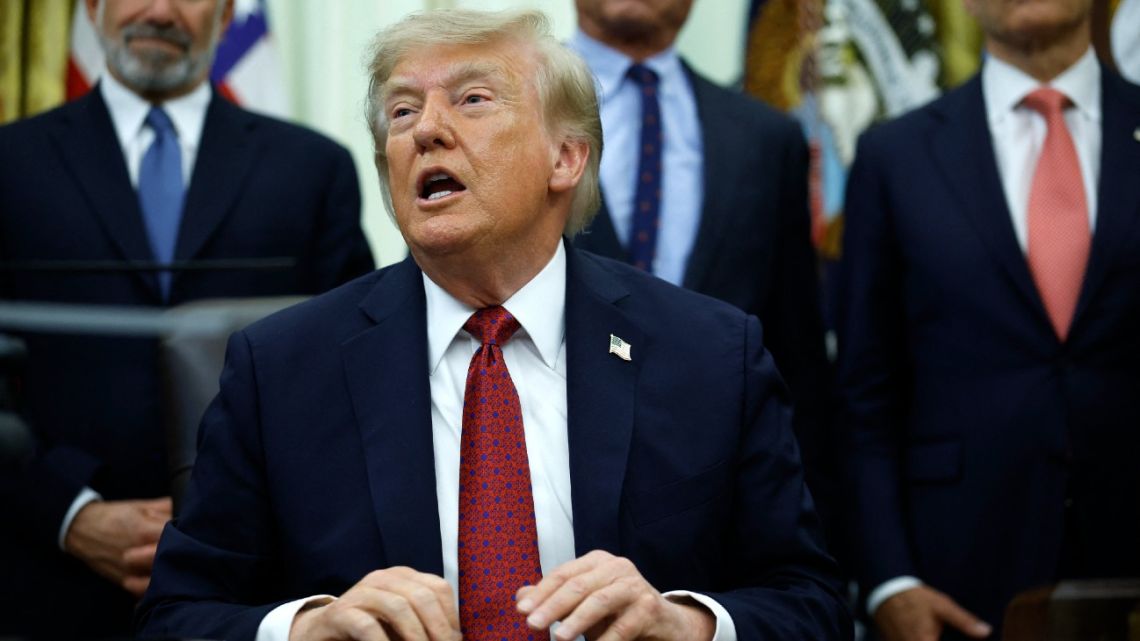
Donald Trump suggested Monday that the United States could review its position on the Malvinas (Falkland) Islands, after reports that Washington threatened to withdraw its support for Britain's sovereignty claim if London does not increase defence spending.
The proposal concerning the South Atlantic archipelago, over which Britain and Argentina went to war in 1982, was among measures being drawn up by the Pentagon to incentivise NATO allies to meet spending pledges, The Daily Telegraph reported last week.
"I always review every position. That's just one of many," Trump told reporters in the Oval Office when asked if the United States was reviewing its position on the islands.
Asked if he wanted the government of new British Prime Minister Andy Burnham to increase Britain's defence spending, Trump replied: "The UK's got some problems but they'll get solved."

Washington recognises Britain's de facto administration of the islands – known in the UK as the Falkland Islands – but maintains a neutral position on the competing sovereignty claims.
The US State Department told the AFP news agency in April when the first reports emerged of a possible review that "our position on The Islands remains one of neutrality."
But the Pentagon review could give Britain "special attention", including the possibility of Washington opposing its sovereignty claim outright, The Telegraph reported.

Argentina has long called for negotiations with Britain over the islands' sovereignty, while London rejects negotiations on sovereignty and maintains that the islanders' right to self-determination must be respected.
Four decades after the conflict, tensions are still high between Britain and Argentina.
Argentina players held up a banner saying "The Malvinas are Argentine" after beating England 2-1 in the World Cup semi-final earlier this year. FIFA later fined the Argentine Football Association US$321,000.

Argentine forces invaded the islands in April 1982, prompting then-British prime minister Margaret Thatcher to send a naval task force to retake them.
The war left 649 Argentines, 255 Britons and three islanders dead.
Then-US president Ronald Reagan initially sought to maintain a neutral position and attempted to mediate between the two sides, but Washington ultimately provided Britain with military and intelligence support after diplomatic efforts failed.
– TIMES/AFP/PERFIL














Comments