

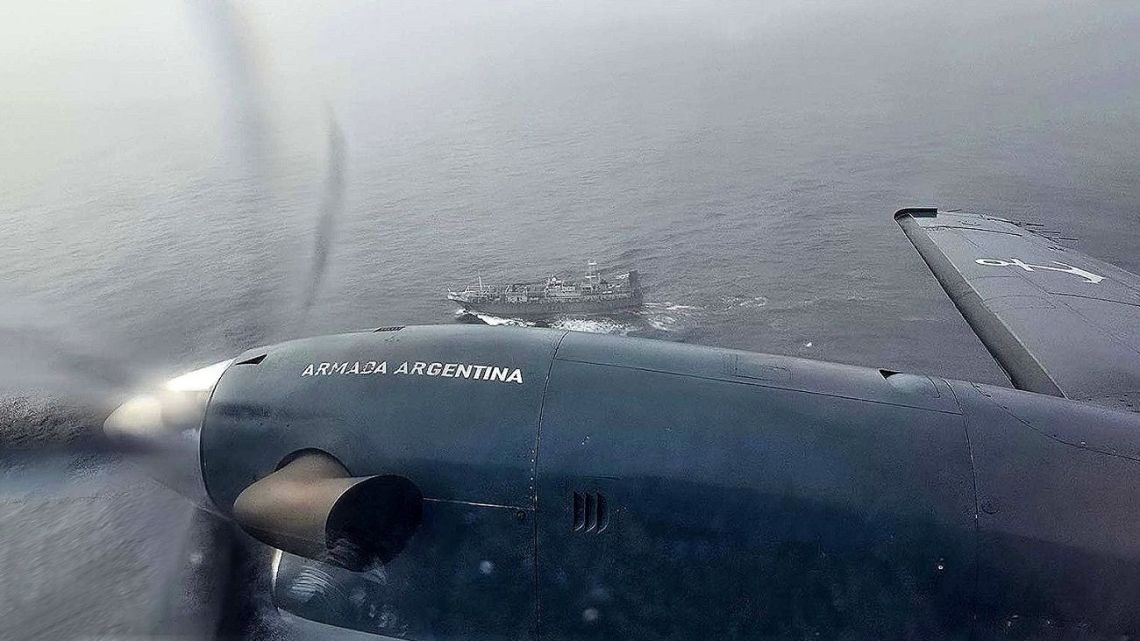
The navies of the United States and Argentina have signed a cooperation agreement to boost maritime vigilance in the South Atlantic, the US Embassy in Buenos Aires has announced.
The deal sits under the framework of the “Protecting Global Commons Program,” an initiative pushed by the US Southern Command to provide technological assistance, training and operational support over the next five years.
The official objective of the programme is to boost regional security and combat maritime threats, among them bootleg fishing and other illegal activities in South Atlantic waters.
The agreement contemplates a first stage of sending two aircraft for maritime patrol while incorporating specialised equipment for an improved capacity to control and monitor the South Atlantic.

The letter of intent was signed by Rear-Admiral Carlos Sardiello, representing the naval forces of the Southern Command and the US Fourth Fleet, and by Admiral Juan Carlos Romay for the Argentine Navy.
The agreement triggered political repercussions and questioning by sectors of the opposition, who warned about the scope of the concept of “global commons” used in the initiative. Buenos Aires Province officials and opposition leaders also pointed out that Argentine waters form part of the country’s sovereign jurisdiction, objecting to possible foreign interference in tasks of maritime vigilance.
The national government interprets the agreement as a further step in the strategic alliance with Washington, highlighting that it will permit a modernisation of naval operational capacities, especially in the area of maritime control and the protection of fisheries.
Details
The cooperation between both countries forms part of Program 333 of Development of Capacities and Association, starting last year as a joint task between Argentina and the US Embassy. According to the official information, some of the stipulated equipment has already been delivered and started to incorporate the operational capacities of the Navy.
One of the first concrete advances came late last year with the modernisation of a B-200M Cormorán aircraft belonging to Argentina’s Naval Aviation. The unit received multispectral sensors, command and control systems, data links and new systems of communications destined to expand its capacity for maritime vigilance.
The equipment was received last September and entered into service three months later at Punta Indio air base. Among the incorporations figures the WESCAM MX-10 system, an electro-optic device with infrared technology designed for tasks of exploration, tracking and vigilance.
The new capacities permit reconnaissance and search and rescue operations, even with low visibility and adverse weather conditions, also broadening the possibilities of air support during operations of maritime interdiction and "Visit, Search and Capture" missions.
The timetable agreed for the next five years also schedules the incorporation of two new TEXTRON B-360ER MPA aircraft, specifically configured for maritime patrols.
The units will have radar to scan the surface, infrared sensors, satellite communications systems, ISR (intelligence, search and recognition) technology and command and control systems to monitor maritime spaces.
Timetable
The timetable establishes that the first aircraft will arrive in this country in December and the second the following June.
The programme also includes the incorporation as from mid-2027, of drones with vertical takeoff. The drones will be able to operate out of naval patrol boats, a capacity permitting expanded reconnaissance and identification of activities at sea without need of crews.
The final stage of cooperation contemplates around 2029, the supply of a simulator destined for the P-3C Orion aircraft recently incorporated into the Argentine Navy.
The incorporation of this system aims at boosting the training of specialised personnel, besides broadening the operational capacities linked to maritime vigilance and control.
The government maintains that the programme’s objective is to increase knowledge of the maritime domain and reinforce Argentine presence in the South Atlantic via the incorporation of new technologies and tools of control.
– TIMES/PERFIL
related news
KKR consortium warns White House of ‘bias’ in US$10-billion Argentina auction

Researchers collect rodents near Ushuaia for hantavirus tests

Vaca Muerta promises flood of dollars, insuring Argentina's next president against any currency crisis













Comments