

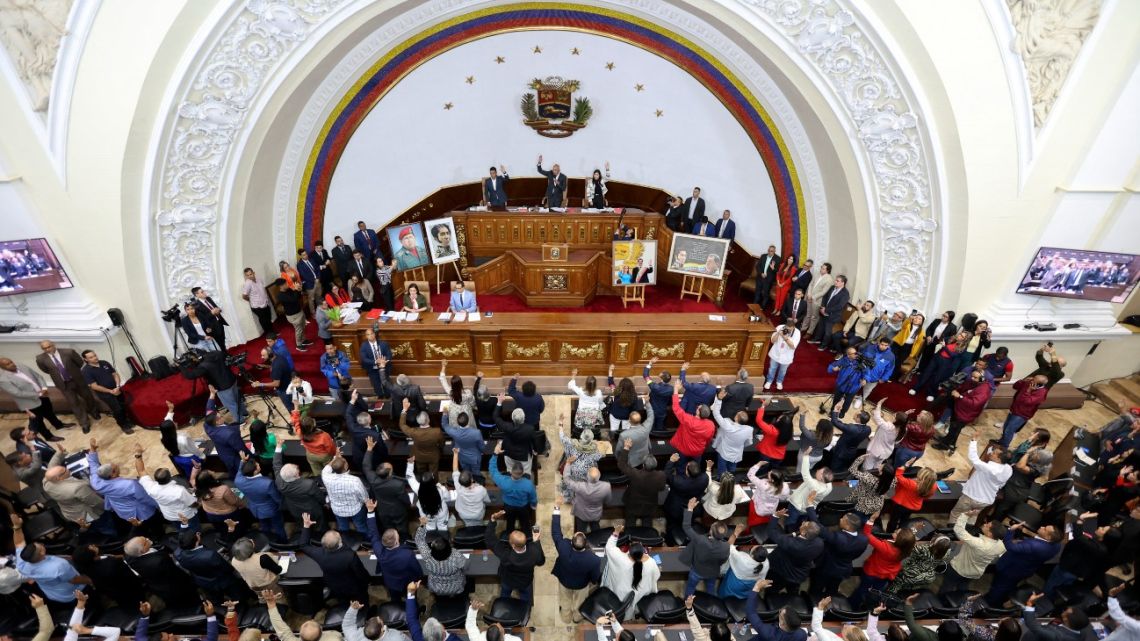
Venezuela's National Assembly on Thursday gave its initial approval to a landmark amnesty bill covering the types of charges used to lock up dissidents under ousted leader Nicolás Maduro and his predecessor Hugo Chávez.
But the bill does not cover serious human rights abuses committed during 27 years of socialist rule.
The legislation, which aims to turn the page on nearly three decades of state repression, marks an early milestone in the post-Maduro transition.
It was spearheaded by interim president Delcy Rodríguez, who replaced Maduro after he was captured by US forces in Caracas last month and flown to New York to face trial.

The Amnesty Law for Democratic Coexistence, which AFP obtained a copy of, covers "treason," "terrorism" and spreading "hate" – charges frequently used to lock up dissidents during "Chavista" rule, under Maduro and Chávez.
Rodríguez hailed parliament's approval on its first reading "a very important step" toward "peace and national reconciliation."
The bill also lifts the ban on running for office for several opposition members, including Nobel Peace Prize laureate María Corina Machado.

Emotions ran high in the National Assembly as it was debated, with Chavista"lawmakers and the opposition alike issuing appeals for reconciliation.
Parliament chief Jorge Rodríguez – brother of the acting president and recently a member of Maduro's inner circle – apologised to Venezuelans for crimes committed by the state since Chávez took power in 1999.
"We ask for forgiveness and we too must forgive," he said, holding up a photograph of Chávez clutching a crucifix.

Opposition MP Tomás Guanipa, who has one brother in prison and another under house arrest, said the bill could mark a "new, historic chapter" for Venezuela, where people would no longer be "afraid to speak their minds for fear of being imprisoned."
Maduro's son, congressman Nicolás Maduro Guerra, added his voice to those calling for unity, saying "Venezuela cannot endure any more acts of revenge."
Lawmakers will take up the bill again on Tuesday for final reading.
Crimes against humanity
The draft law covers events such as the failed 2002 coup against Chávez, various cycles of protests between 2004 and 2024, and criticism posted on social media or messaging services.
Crucially, it does not grant amnesty for "serious violations of human rights, crimes against humanity, war crimes, intentional homicide, corruption, and drug-trafficking," which cannot be pardoned under the Constitution.
The bill does however cover unspecified "offences" committed by judges, prosecutors and other officials.
The announcement last week of a general amnesty triggered scenes of rejoicing across Venezuela, fuelling hopes for the speedy release of hundreds of political prisoners still behind bars a month after Maduro's ouster.
The director of the country's leading human rights NGO, Foro Penal, welcomed the draft law as a major step toward reconciling a deeply divided country.
"Amnesty is the framework that will ensure... that the past does not serve to halt or derail transition processes," Alfredo Romero told AFP.
Some Venezuelans have expressed hopes of seeing all of Maduro's inner circle brought to justice.
But Romero warned: "A reconciliation, a transition, cannot be a process of persecution against those who previously held power."
'Forceful message'
Thursday's parliamentary debate coincided with a new round of talks between the government and a faction of the Venezuelan opposition that has distanced itself from a majority wing led by Machado.
The opposition is seeking fresh elections to replace those held in July 2024, and which Maduro claimed to have won despite no official figures ever being released.
Much of the world thinks he stole the vote.
Maduro acolytes were left in power after American troops whisked him away in cuffs to stand trial on drug charges in New York.
Trump backed Delcy Rodríguez, Maduro's former vice-president, to take over, making clear his priority was stability rather than democracy.
Rodríguez has shown a willingness to cooperate. Her government has released hundreds of political prisoners and taken steps toward restoring diplomatic ties with Washington, which were severed in 2019.
related news



by Javier Tovar & Margioni Bermúdez, AFP




Comments