

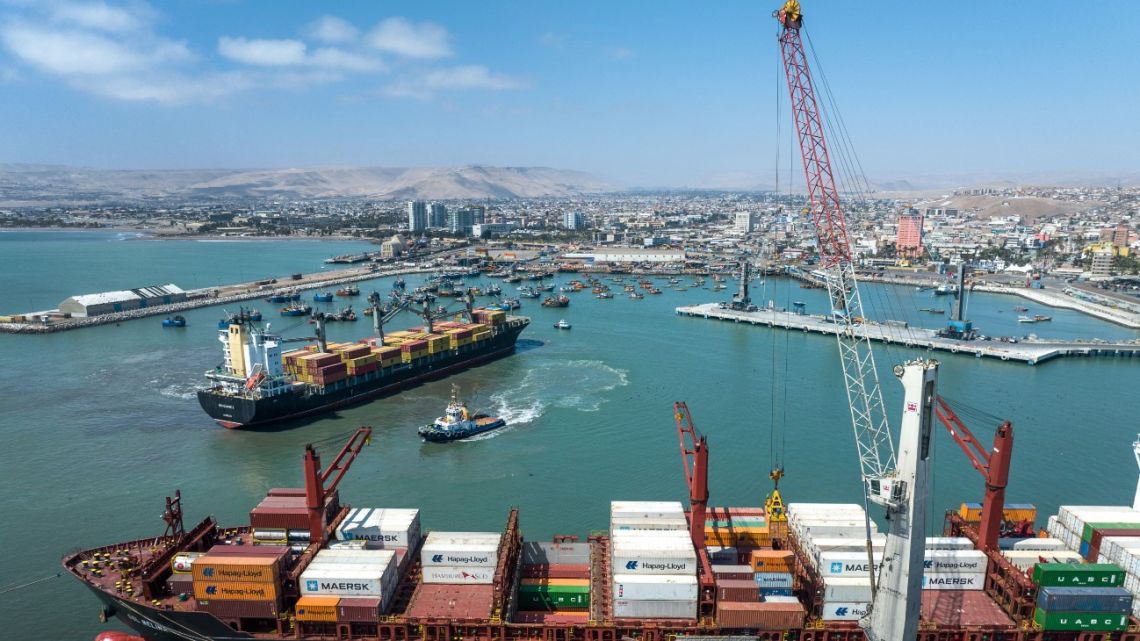
Chile for decades finessed the geopolitical rivalry between China, its top trading partner, and the US, its leading foreign investor. Those days seem to be over.
Just days ahead of a summit of Latin American leaders in Miami and two weeks before a right-wing government takes over in Santiago, the US imposed visa restrictions on three Chilean officials tied to an undersea digital cable project proposed by Chinese firms, alleging a security threat. The rare move sent a warning to the region that it must now choose sides as US President Donald Trump strives to reassert dominion over the Americas.
The US ambassador to Chile, Brandon Judd, told reporters on Monday that the Trump administration warned the government over malign foreign hacking into its telecommunication network, and urged the country to screen investments or it could lose a longstanding visa waiver policy that allows most Chileans to easily travel to the United States.
The diplomat emphasised that the US respects every country’s right to trade and insisted Washington isn’t challenging Chile’s sovereignty. “The only action we took was choosing who can come into our country.”

The US posture is prompting calls for soul searching in Santiago.
“Chile has to start thinking strategically in a changing scenario of geopolitical confrontation,” said John Griffiths, an analyst at security-focused think tank AthenaLab in Santiago. “Like it or not, the Trump administration is acting in its national interest in a region it sees as its sphere of influence,” said Griffiths, who’s also a former Army general in Chile.
The choice the Trump administration is imposing could come at a high price. China buys most of the region’s commodities and has made substantial investments in infrastructure, especially ports.

After Panama’s Supreme Court voided a contract last month with Hong Kong-based CK Hutchison Holdings Ltd. to operate two ports along its namesake canal, Beijing retaliated by asking its state firms to halt talks over billions of dollars in new projects. It also tightened customs inspections on Panamanian banana and coffee shipments.
Elsewhere, the US seems to be playing catch-up. After the Chinese inaugurated a sprawling port in Peru in 2024, the Trump administration warned of security risks and a loss of sovereignty for the Andean nation. The Trump administration is now floating a US$1.5-billion plan to support construction of a nearby naval base.
In Argentina, the government of Trump ally Javier Milei has thwarted a Chinese telescope project, maintained a freeze on a proposed Beijing-backed nuclear plant valued at US$8 billion, and blocked a Chinese company from bidding on dredging work.

“The Chinese are moving incredibly aggressively into the Western Hemisphere, into South America,” Mike Waltz, the US envoy to the United Nations, told Fox News in January. He added that Trump and US Secretary of State Marco Rubio are strenuously pushing back.
The White House desire to revive the 19th-century Monroe Doctrine set out in a new US national security plan unveiled late last year was also on full display in Venezuela on January 3 when US forces swept in to seize Nicolás Maduro. Prior to that, Venezuela was shipping most of its crude oil to Chinese buyers.
US pressure is more nuanced in Brazil, where left-wing President Luiz Inácio Lula da Silva has made sure to stay in the good graces of Trump and his Chinese counterpart, Xi Jinping.
New tensions
Chile, the world’s largest copper producer and a strategic gateway to Antarctica, has faced US pressure before. Last year, the Trump administration urged the government to scrap a Chinese telescope project in the Atacama desert, an astronomical heartland. Back in 2021, the US pressured Chile to cancel a Chinese-German deal to produce its passports and identity cards.
The stakes are higher this time. The sub-sea cable that Chinese companies proposed installing from Chile to Hong Kong is not entirely about technology, but also national security since 85 percent of information now travels through such connections, Griffiths said. Chile already has a deal with Alphabet Inc’s Google to build a cable to Australia.
In a statement Saturday, China’s Embassy in Chile accused the US of showing “obvious contempt for Chile’s sovereignty, dignity and national interests.”
A spokesperson from the government of Chile’s outgoing leftist President Gabriel Boric expressed a similar sentiment on Monday. “Faced with this reprehensible and unacceptable conduct, we’d like to remind everyone that Chile is a sovereign country.”
The new tensions are surfacing just as Boric, a frequent Trump critic who denounced the visa restrictions, prepares to hand power to José Antonio Kast, an arch-conservative that the Trump administration – especially Rubio – has openly supported.
An anti-immigration critic like Trump, the incoming president will attend the “Shield of the Americas” summit in Miami next week alongside several other Trump-friendly leaders from the region, ahead of Kast’s March 11 inauguration. Leaders from Latin America’s biggest nations led by leftists, especially Mexico and Brazil, are not attending the Miami meetings.
Little is known about Kast’s foreign policy, aside from recent overseas visits to Hungary, Italy and El Salvador to promote his anti-migrant, anti-crime platform. Businessman Francisco Pérez Mackenna, Kast’s pick to be foreign minister, said it would be inappropriate to comment before Kast takes office.
But as he packs his bags for a summit with like-minded conservatives, Kast is expected to toe the anti-China line — up to a point.
Chile is the world’s leading copper producer, and China imports most of it. It also buys nearly all of Chile’s cherries and other fruit. In the energy sector, Chinese companies are major actors in Chile’s power transmission and distribution networks.
In that context, the US isn’t providing any positive incentives for countries like Chile to cooperate, said Paulina Astroza, a political analyst at the University of Concepción. The move to restrict the visas “reflects the traditional ‘stick’ policy — but the carrots are nowhere to be seen.”
related news



by Patricia Garip & Antonia Mufarech, Bloomberg






Comments