

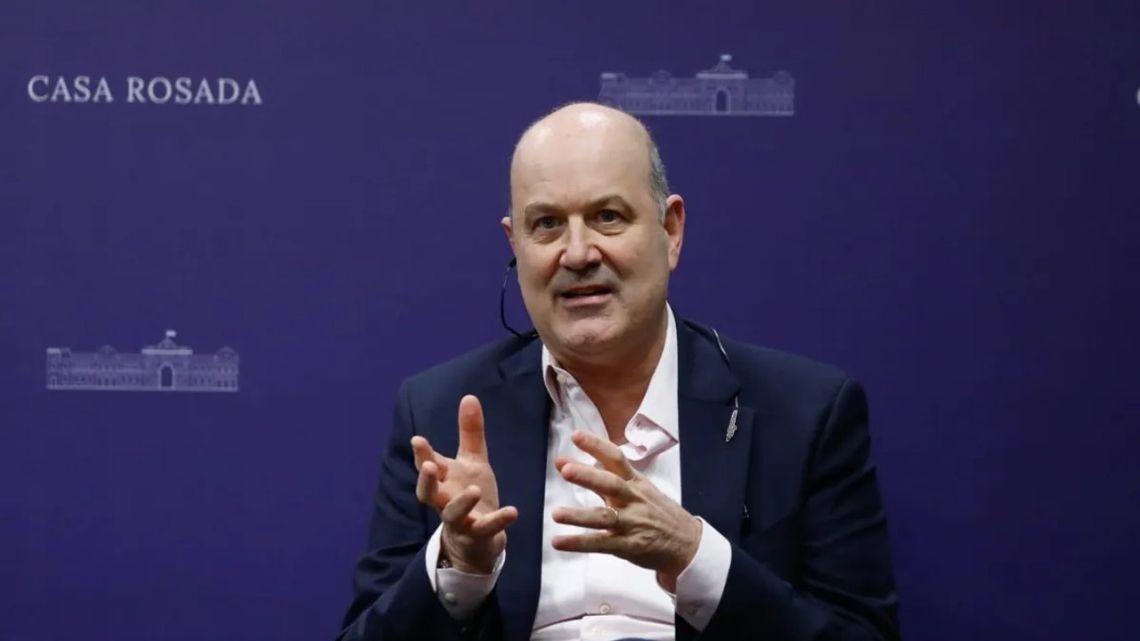
As President Javier Milei previously anticipated, the La Libertad Avanza administration continues to consider what cuts can be made department by department. The man in charge executing this state policy is Federico Sturzenegger, Milei’s Deregulation & State Transformation minister.
Officials from Sturzenegger’s department have been spotted visiting various ministries in recent weeks, according to sources. The objective is to assess how many people are employed, what roles they fulfil, and whether current staffing levels are necessary.
Crucially, they want to see if the same tasks can be achieved with fewer personnel.
As one minister revealed to Noticias Argentinas, every time Sturzenegger’s team turns up at the offices, they make it abundantly clear that there is a need to press ahead with further staff cuts in the second half of the year, ideally across every government department.

In other words, Milei’s famous chainsaw is not going to be turned off. Front-line officials estimate there will be no difficulties in meeting the austerity targets. However, other personnel working within the Milei administration are not as optimistic; they believe that sacking employees will cause operational difficulties for management.
Protesting further cuts, the ATE state workers association is promising a battle and vows to bring conflicts to light during the final part of the year. "We cannot stay silent or march willingly to the slaughterhouse. We are going to confront them," warned its leader Rodolfo Aguiar recently. The union leader also warned that "pay negotiations must be reopened immediately and, if that doesn't happen, we are going to fill the state sector with industrial action."
At the Unión de Personal Civil de la Nación (UPCN) – the civil servants’ union led by Andrés Rodríguez – the view of the government’s plans is bleak. However, they avoided commenting on whether there would be industrial action. "We view with great concern that this government has generated a very harsh austerity policy, especially within the National State," was the initial analysis.

The UPCN highlighted that the government has dismissed "a huge number of colleagues with more than 10 years of seniority – highly trained and prepared individuals who proved as much when they had to sit the exam this government gave to all workers, which was passed by 95 percent of them."
"They keep sacking people, and what is most worrying is that salary levels are, unfortunately, losing their purchasing power," sources told Noticias Argentinas.
"For the future, we believe the State should be an entity that serves society with social justice; a society that is truly being neglected at the moment. This has to change because the State belongs to the community, not to a government.

“Therefore, we can talk about making it as efficient as necessary, but never about destroying it or leaving it in a totally vulnerable state that fails to support the people who need the State the most," they concluded.
by Juan Pablo Kavanagh, Noticias Argentinas














Comments