

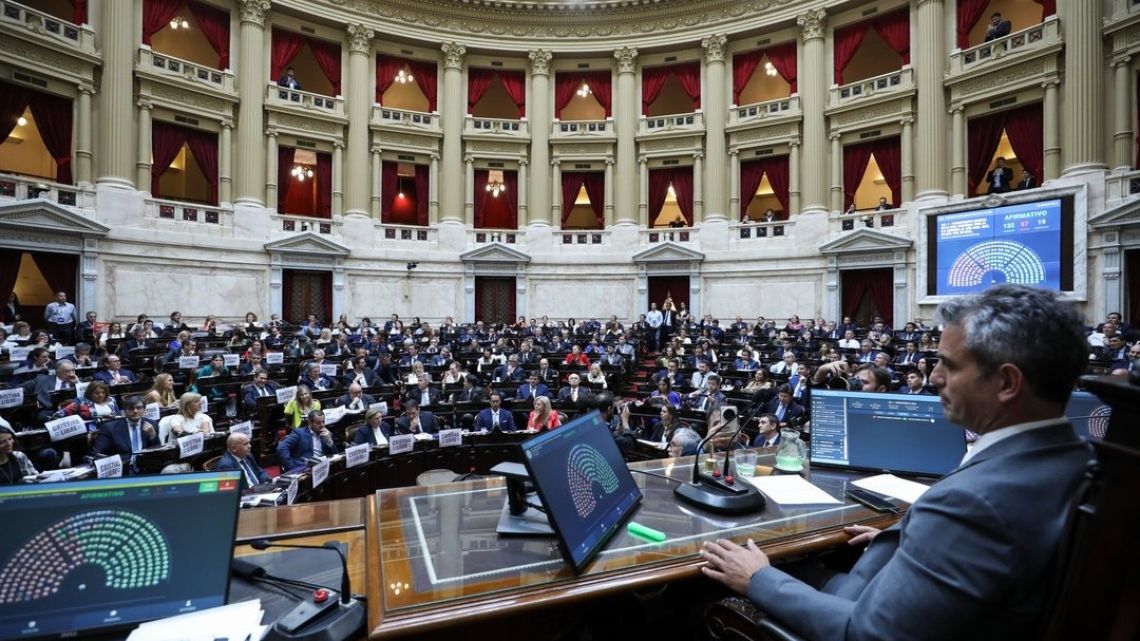
President Javier Milei’s ruling party has cleared its first hurdle in Argentina’s new Congress, securing passage of the government’s 2026 Budget bill through the lower house.
After a lengthy session in the Chamber of Deputies, Milei’s La Libertad Avanza managed to pass the bill, though it suffered a setback when it failed to uphold a controversial article seeking the repeal of last year’s emergency laws on disability and university funding.
The bill was approved in general terms with 132 votes in favour, 97 against and 17 abstentions, with 117 in favour and 123 against for the repeal articles.
The bill has now been sent to the Senate without “Chapter 11,” the section of text which includes the repeal push and several other contentious points.

With the ruling party’s ranks in the lower house now boosted as a result of its victory in the October midterms, the 2026 Budget debate was the first test of Milei’s support in Congress.
In the general vote, as expected, La Libertad Avanza rallied its allies from other caucuses, including PRO, the Unión Cívica Radical (UCR), Innovación Federal and other minority forces.
The Peronist opposition, grouped under Unión por la Patria, and left-wing alliance Frente de Izquierda y de los Trabajadores–Unidad (FIT-U) voted against, while centrists Provincias Unidas abstained.

The session was fiery, with several lawmakers complaining that the government had made several last-minute changes to the bill – not least the attempt to repeal the two laws passed by both houses last year.
Those laws declared emergencies in the disability and state university sectors, boosting public spending on both.
The laws were initially approved by both chambers last year, then were vetoed by Milei, before being ratified by Congress again.

These proposals, however, were ultimately removed with the rejection of Chapter 11.
Milei's government is said to be considering whether to reintroduce them and several other items when the bill reaches the Senate.
The ruling party’s budget bill has been criticised by some economists for its optimistic outlook. It predicts annual inflation of 10.4 percent, economic growth of five percent and an exchange rate of 1,423 pesos per US dollar by December 2026.

It estimates that the government will record a surplus of 1.5 percent of GDP and allocate 85 percent of its resources to welfare and social support.
It also prevents the National Treasury from financing itself through the Central Bank and predicts an export boost of 10.6 percent year-on-year, with imports surging 11.1 percent.
– TIMES/NA

















Comments