

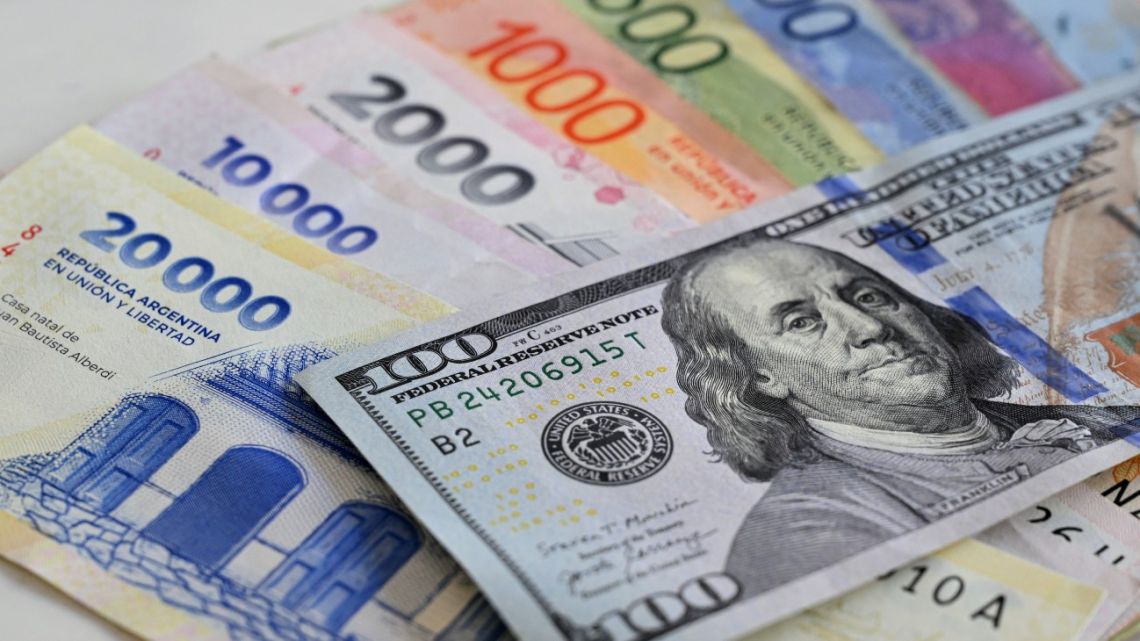
Every morning at Argentina’s Central Bank, traders on its foreign exchange desk start with a simple mission: keep the peso from moving too far up or down.
Most recently, they’ve been successful as the peso weakened by less than one percent in November, its smallest monthly move all year for the worst performer in emerging markets. It’s remained flat in December too. Instead of targeting a specific exchange rate, the traders aim to curb volatility day by day, trying to prevent sell-offs just as much as sharp rallies, according to a person with direct knowledge of the matter.
Now the Central Bank’s FX desk is about to play a more prominent role as President Javier Milei seeks to accumulate reserves at the institution, a task he’s postponed for his first two years in office. But it’s just one ingredient of a policy shift where the monetary authority will operate in and outside the market.
The aim is to stockpile reserves without lighting up investors’ computer screens with a wall of currency bids that would send the peso weaker and risk fanning inflation that’s cooled significantly and kept Milei’s popularity above his peers.

Starting next year, traders at Argentina’s Central Bank will buy up to five percent of the daily trading volume in Argentina’s currency market. However, with volume hovering at low levels near US$300 million a day and fluctuating rapidly, officials’ presence may be more felt in so-called block trades outside the market where the government buys dollars directly from institutions without throwing pesos into circulation.
That dynamic was on display Monday when the Treasury purchased US$320 million “off screen,” or outside the market, completely eclipsing all the trading volume inside Argentina’s currency market that day, according to Central Bank Governor Santiago Bausili. He added that the Treasury’s dollar purchases are related to Argentina’s upcoming bond payments of US$4.5 billion in January.
Net dollar holdings in Argentina’s Treasury rose to US$1.7 billion as of December 12, official data show, driven by FX purchases and a local bond issuance. Including Monday’s purchase disclosed by Bausili would put the current stock near US$2 billion, roughly half of what’s needed to cover January bond payments.

“All of this is because they have to find a way to reconcile some control over the exchange rate with the need to buy dollars for the Treasury,” said Gabriel Caamaño, an economist at consulting firm Outlier.
In a dual-currency economy like Argentina’s, where locals save in dollars but earn and spend in pesos, volatility is a big problem. It can erode demand for pesos, spark a flight to dollars and derail Milei’s push to crush inflation, now 31 percent annually, into single digits.
More analysts are warning Milei’s new policy pivot – while widely seen as positive – also risks fuelling inflation. Besides accumulating more dollars in the market, and conversely selling pesos, the Central Bank will let the range the peso trades within expand at a faster pace, loosening its grip and thereby opening the door to more volatility that could spill over into prices.

“Right now the exchange rate is the only tool they have to anchor inflation, given that they want to cut rates,” said Walter Stoeppelwerth, chief investment officer at local broker Grit Capital Group. “Inflation is still a problem and the market is being very complacent about it.”
To tame the peso and prices, the government is deploying more block trades outside the market, directly buying and selling from commercial banks and debt issuers. Selling directly to the government often makes more sense for them than going through the traditional FX market, which has such little volume that a large offer can quickly swing the peso and leave sellers with fewer pesos than expected. The government offers a single price.
Some of the hard currency the government is buying outside the market comes from a fresh wave of corporate and provincial debt sales after Milei’s big midterm election victory, which added much-needed dollar liquidity. In recent weeks, more than a dozen debt issuers – including energy companies such as Vista Energy, Tecpetrol and YPF, as well as several provinces – have begun supplying dollars to Argentina’s market.

Per Argentine regulations, debt issuers must eventually convert the proceeds of their bond sales into pesos before the first coupon payment comes due. Córdoba Province, for example, faces a coupon on January 2 and will have to sell its dollars before December 26 to make the payment on time and in full.
Even before those deadlines, issuers have reasons to sell: many provinces and companies need pesos to fund investment projects and yields are more attractive in Argentina.
As Milei seeks to amass foreign reserves, these sellers outside the FX market could prove key to keeping calm inside it.
related news


by Ignacio Olivera Doll & David Feliba, Bloomberg








Comments