

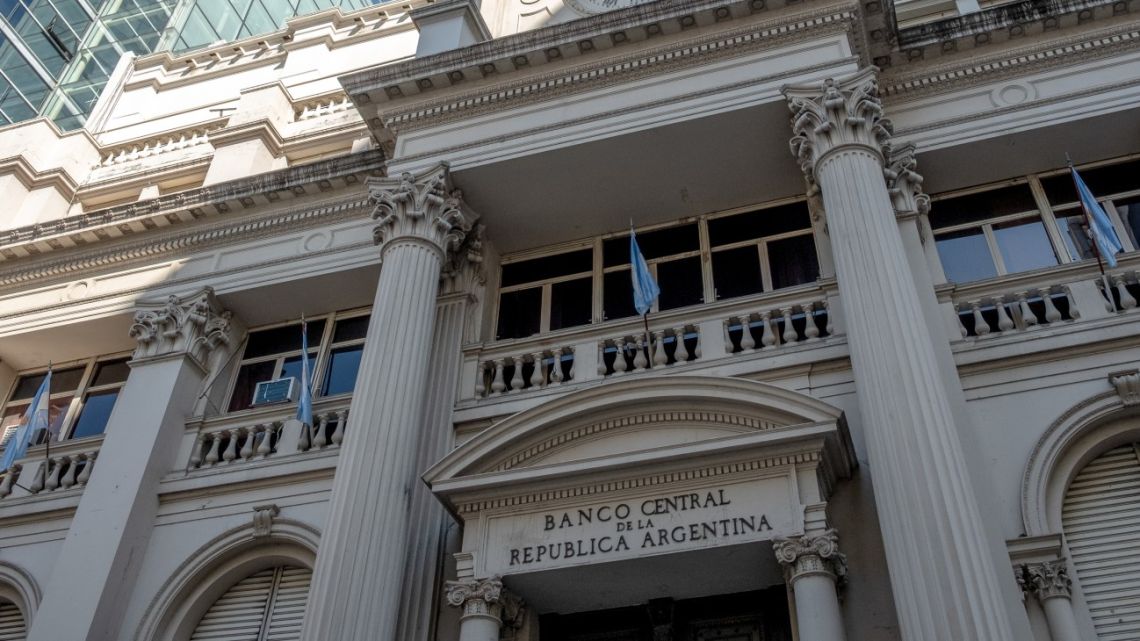
Even after easing Argentina’s tight grip on its currency, President Javier Milei is sticking with a core approach: intervene, manage and prop up the peso, in an effort to keep inflation down.
On January 1, the Central Bank started letting the peso trade within a range that expands at the pace of monthly inflation and embarked on a plan to accumulate foreign reserves. Both measures won praise on Wall Street as sensible fine tuning to an economic framework investors widely applaud.
Behind the scenes, monetary officials are deploying another strategy to counter the impact of pesos going into the market from the Central Bank’s dollar purchases. They’ve ramped up sales to record levels of securities tied to the official exchange rate, known as dollar-linked. To entice buyers, Milei’s Central Bank is offering the notes at prices meaningfully cheaper than the official rate – a discount that’s lured investors with implied returns of about 18 percent a year in dollar terms.
The strategy is a complement to Milei’s plan to accumulate foreign reserves. In practice, it’s intervention that also doubles as a form of mopping up excess pesos in the market.

“It’s a way for the Central Bank to intervene in the FX market and support the peso without using dollars, since these debt securities settle in pesos,” said Daniel Chodos, a partner at Buenos Aires-based Dhalmore Capital. “By selling these instruments, it offers cheap FX hedges. That creates incentives to sell spot dollars and buy these securities.”
The government is trying to entice banks, funds and companies with instruments that provide currency protection at an attractive price, nudging them to sell dollars in the market while staying long on the greenback through securities tied to a future devaluation. That helps the Central Bank draw in dollars while shifting part of the hedging demand into the debt market.
A Central Bank spokesperson declined to comment.

Trading volume in dollar-linked bonds maturing January 16 and January 30 surged from marginal levels in July – just a few billion pesos per session – to record highs over the past month, topping 500 billion pesos (US$341 million) in recent days. Over the same period, the Central Bank bought about US$273 million and its foreign reserves hit a three-year high.
The Central Bank has stepped up its use of these securities to shore up the official exchange rate and steer it closer to 1,450 pesos per US dollar. The intervention serves as a bridge between the political goal of avoiding abrupt moves in the peso and the financial need to rebuild firepower in a country where scarce hard currency often dictates market sentiment.
“The Central Bank is pressing all the buttons at once,” said Juan Manuel Truffa, a partner at Buenos Aires-based consultancy Outlier. “It expands by buying dollars for reserves, but tightens by selling dollar-linked notes and futures, trying to keep the exchange rate in place.”

Milei’s strategy has two advantages: by selling these securities, the Central Bank mops up pesos and reduces dollar demand, mitigating a potential currency sell-off. At the same time, it offers investors seeking FX protection a more manageable peso-denominated alternative to buying cash dollars outright.
But the cost is drawing growing scrutiny in market notes. The dollar returns the Central Bank is effectively conceding to pin the exchange rate where it wants it are already around 18 percent a year or more — roughly twice what many hard-currency sovereign bonds yield.
Selling hedges through these instruments may help coax banks to offload greenbacks and switch into the dollar-linked securities, but it can also carry side effects. It can strain market liquidity, showing up in volatile money-market rates such as guaranteed loans, which at times spike into triple digits.

The risk isn’t just about price. As the stock of dollar-linked debt grows, so does the government’s exposure if the peso suffers another sell-off after losing nearly 30 percent against the dollar last year, the most in emerging markets.
The government’s total dollar-linked issuance now stands at US$9.3 billion, roughly half of which is held by the Central Bank.
by Ignacio Olivera Doll, Bloomberg










Comments