

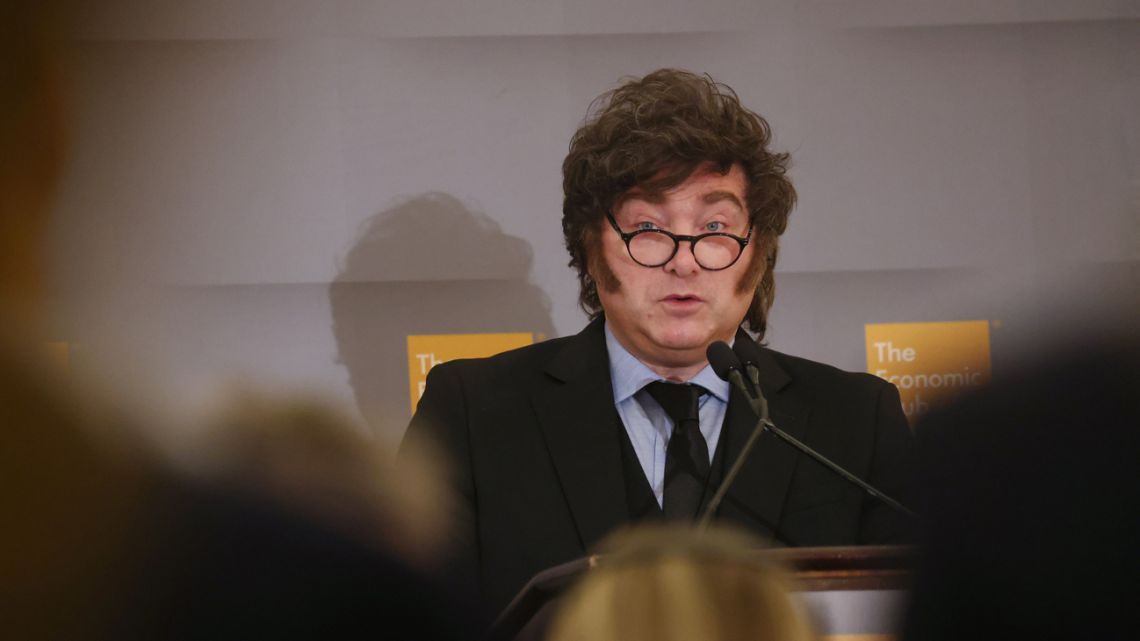
President Javier Milei downplayed concerns about Argentina’s stalling economy, touting consistent annual growth that’s left him “very calm” about his chances to win another term next year.
“We don’t see a problem with growth,” Milei said Thursday in an interview with Bloomberg News Editor-In-Chief John Micklethwait at the Economic Club of New York. “This year, we’re going to grow around three percent, perhaps a little less, and next year is expected to be more or less similar.”
Milei has successfully wrangled triple-digit inflation downward since he took office three years ago. But the economy contracted by 0.6 percent in the second quarter, the first quarterly decline in two years.
Economists surveyed by the Central Bank also cut their growth forecast to 2.1 percent in August, from their December estimate of 3.5 percent. Data published later Thursday showed economic activity contracted 2.9 percent in July from a month prior, far worse than expectations. It also shrunk 1.4 percent on an annual basis, while poverty rose in the first half of the year.

The slowdown has left analysts debating whether Argentina is at risk of slipping into a technical recession this year, while stoking investor concerns that the market-friendly leader will face a tough reelection battle. Polls showing that voters are now more troubled by unemployment than inflation have amplified his challenge.
Milei’s approval rating sat at 38 percent in August, near the lowest levels of his Presidency, according to an AtlasIntel poll for Bloomberg News. Some 70 percent of Argentines described the labour market as bad, the survey showed. Milei wrote off polls as unreliable in Argentina.
Argentina has lost nearly 250,000 private sector payroll jobs since just before Milei took office, and unemployment has ticked up to nearly eight percent.

“Very weak July activity figures returned Argentina’s economy nearly to its level when Javier Milei took office and will probably add to downbeat market sentiment. Investors are likely to worry that soft activity and weak labor-market conditions could compromise the president’s reelection prospects next year.”
—Jimena Zúñiga, Argentina economist
But Milei blamed slower growth on weighted indexes that don’t take into account what he called Argentina’s structural transformation, particularly its booming oil and gas sector. He similarly countered that the economy had created 520,000 jobs, but that many are overlooked because they’re informal.
“What’s happening is that these jobs are being created in the informal sector,” he said.
Analysts point to Milei’s quest to contain prices as the main culprit behind sluggish growth. Argentina’s peso weakened 3.7 percent against the dollar this year through August, while consumer prices sped up 21 percent. That real appreciation has been bolstered in recent weeks by official intervention in bond and futures markets, while monetary policy remains restrictive.
‘Not as libertarian as I’d like’
Milei argued that the growth of informal labour is due in large part to private sector fears of a return to the interventionist policies of his opponents in next year’s election. He pointed specifically to Buenos Aires Province Governor Axel Kicillof, who is considered Milei’s most likely opponent and is a traditional ally of leftist former president Cristina Fernández de Kirchner.
The opposition is also behind Argentina’s lingering capital controls, Milei said. Although he has loosened currency policy, Argentina still uses a managed exchange rate — known as a “dirty float” — and has maintained some restrictions on the dividends companies can repatriate.
“We have to take precautions,” Milei said. “I’m not as anarchist as I’d like to be or as libertarian as I’d like to be. But I have a responsibility to govern for 48 million people, knowing that on the other side there are people who are willing to break everything. I’m crazy, but I’m not eating glass.”
Ahead of the 2027 general election, Argentina is also scheduled to hold a preliminary nationwide primary known as the PASO that typically provides an early gauge of voter preferences. Milei sent Congress legislation to scrap the PASO earlier this year, a bid to avoid market volatility that has resulted in the past.
“Politics isn’t my thing,” Milei said when asked why the legislation has stalled.
The vote has, in previous cycles, led to deteriorating Central Bank reserves as Argentines purchase dollars to hedge their savings amid election uncertainty.
But Milei said the push to eliminate the PASO is meant to get rid of what he described as a tool of “dirty politics,” rather than political calculations.
US trade deal
Argentina is continuing to work on new US tariff exemptions, Milei said, a nod to the fact that Argentina still hasn’t ratified the trade agreement it signed with President Donald Trump’s administration in February.
The government has pushed to renegotiate some terms of the deal in the wake of the US Supreme Court’s ruling on Trump’s global tariffs, Bloomberg News reported Tuesday.
Although Trump has called Milei “my favourite president,” his policymakers flew to Buenos Aires in recent weeks to deliver a clear message: renegotiation is off the table.
Milei also reiterated Argentina’s claims to the Malvinas (Falkland) Islands, a British-controlled overseas territory at the centreof a long-running territorial dispute.
“We are the owners of the islands by geography, by law and by history,” he said of the Malvinas, as they are known in Argentina.
related news
by Manuela Tobias, Bloomberg





Comments