

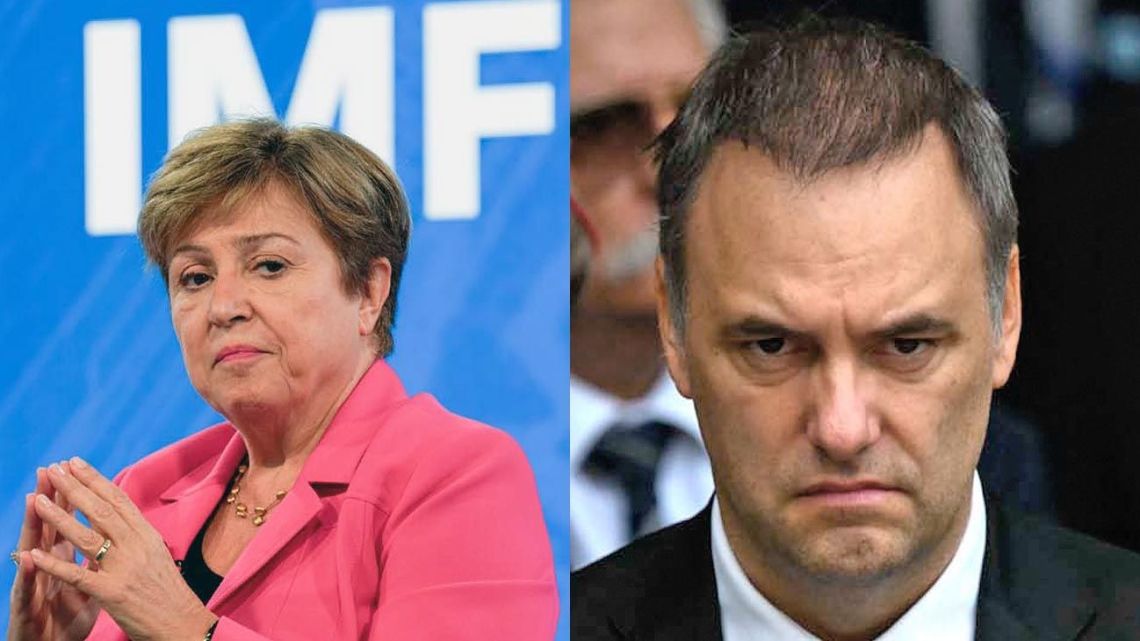
The International Monetary Fund has levelled criticism of President Javier Milei government’s management of anti-corruption policies and the laxity with which it oversees officials' asset declarations.
This is the first time the multilateral lender has expressed itself in such harsh terms, at least since Argentina returned to IMF borrowing in 2018. The concerns are included in the second review of Article IV, which approved a US$1.05 billion disbursement to the country last month – funds delivered despite the government once again missing Central Bank reserve targets.
The IMF, headed by Kristalina Georgieva, listed the fight against corruption as among the “outstanding challenges” facing Argentina. It notes that the country “scored 36 out of 100 in the Corruption Perception Index for 2025 as reported by Transparency International, while the US Investment Climate Statement and other indicators point to persistent challenges.”
The Fund’s concerns are detailed further down in Box 9, where it reviewed "recent progress" in the fight against corruption.

“Preventive anticorruption frameworks need strengthening, with asset declaration regimes characterised by limited verification, low transparency, delayed publication, and uneven enforcement. Conflict of interest rules remain constrained by porous rules and weak enforcement capacity,” reads the IMF assessment.
“Perceived limited judicial independence and politicisation remain concerns, as international
assessments and domestic observers continue to point to delays in high‑profile cases and limited accountability for senior officials, underscoring the need to strengthen prosecutorial independence and judicial transparency,” it concludes.
In total, the word “corruption” is repeated 16 times across the report’s 136 pages.
Rare escalation
The remarks are a rare escalation of tone for the Fund, using language not seen during the tenures of Martín Guzmán, Silvina Batakis, or Sergio Massa, the officials who oversaw the Economy Ministry during ex-president Alberto Fernández’s 2019-2023 government. Nor were such words used when the Executive branch was led by Mauricio Macri, who in his 2015-2019 term in office saw Luis ‘Toto’ Caputo, Nicolás Dujovne (who paired with ‘Toto’ in a split ministry) and Hernán Lacunza in talks with the IMF.
The administration of Fernández, Milei’s predecessor in office, was criticised on many fronts by IMF officials, but corruption was not among them. A 2022 Fund report highlighted that “strong efforts [are] underway to improve governance, financial integrity, and transparency frameworks to ensure compliance with international standards and support anti-corruption” policies.
In 2018, the IMF adopted a Framework for Enhanced Engagement on Governance, a framework which allows it to assess how corruption or institutional weaknesses might affect a country’s economy. Since then, an analytical section has been added for every nation.
Former Argentine ministers who dealt face-to-face with the Fund clarified to Perfil that the remarks were unusual. “What they have written now has never happened before,” said one source, who preferred to remain anonymous. Some consulted by this media outlet said that during their tenures,transparency was not in doubt. The current document specifically mentions asset declarations, judicial independence, and the fall in the corruption perceptions index.
“It is impossible not to mention it. The IMF’s reputation is at stake, which took a hit after the loan during the Macri period,” said one individual with years of experience dealing with the Fund, who said the Fund’s report is an attempt to exert pressure on the Milei government.
The review is conducted by the technical staff. The mention is likely due to the stance of the member countries, who do not want to be “associated” with Milei's bailout – which originated from the political instruction of US President Donald Trump.
Senior sources consulted by PERFIL considered that there is no specified sanction if the Government fails to follow these measures instructed by the Fund. The only thing that could carry penalties – and potentially the disruption of disbursements – would be a failure to meet macroeconomic targets. Nevertheless, Caputo once again requested a “waiver” for the reserves target.
At Suramericana Visión, the consultancy and think tank led by former economy minister Martin Guzmán, analysts noted that “the government’s refusal in 2025 to accumulate reserves (which would have meant a slower pace of disinflation and a higher exchange rate) worsened the inconsistency of the initial IMF programme. Thus, a faster pace of accumulation and more voluminous access to the international debt market are now required – conditions that will be very difficult to meet in an election year like 2027.”
Adorni’s deadline
The deadline for officials to submit their sworn asset declarations, which was due to expire on May 30 has been extended by the Executive to July 31. Officials now have two more months to complete the forms they are legally required to present to the Anti-Corruption Office.
In the eye of the political storm is Chief of Cabinet Manuel Adorni, who has yet to submit his financial statement amidst the scandal over newly discovered properties owned by him and his family that did not appear in his previous filings.
Properties purchased by Adorni since becoming an official, funded by murky private loans, combined with the millions of pesos in expenditures he suddenly began making, have risen doubts about the origin of the funds.
The illicit enrichment investigation against the official, which is currently moving through the courts, is gathering evidence that further complicates the situation for the former presidential spokesperson, who refuses to offer explanations on the matter.
According to him, he is remaining silent so as “not to obstruct the work of the Judiciary.”
The IMF, as can be gathered from the document, does not agree.












Comments