

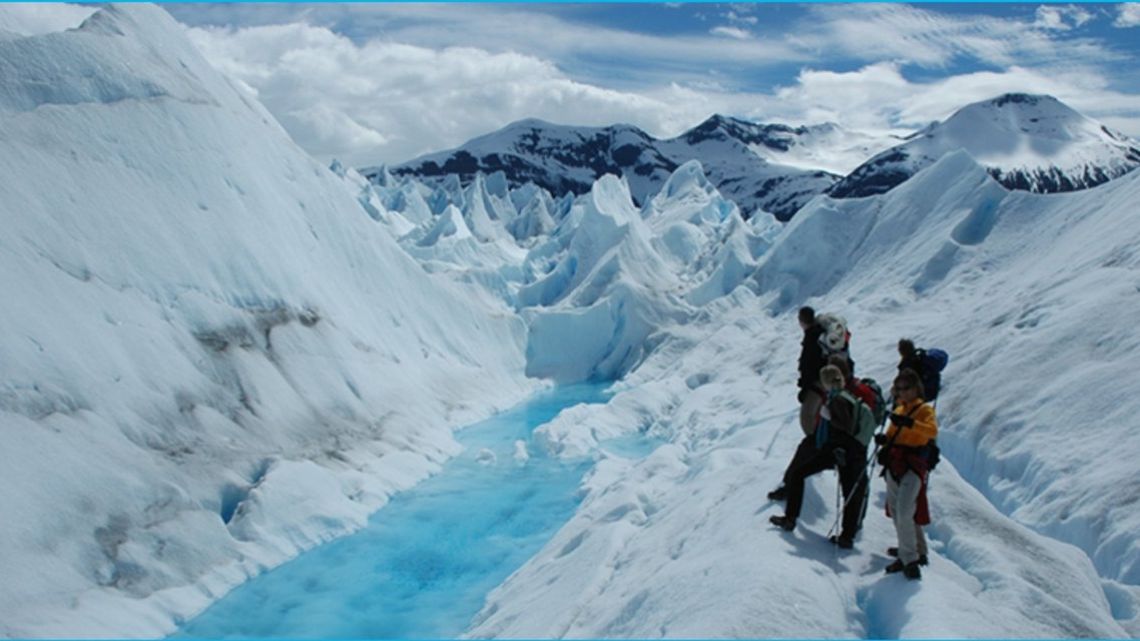
Catholic Church leaders in Argentina have expressed their “deep concern” over potential changes to Argentina’s National Glacier Law, urging lawmakers to block any push by President Javier Milei’s government to weaken protections.
The Social Pastoral Episcopal Commission, a body of the Argentine Episcopal Conference or Synod, on Thursday published an open letter addressed to deputies and senators calling on them to fully assess the environmental impact of changes to the Ley Nacional de Glaciares (Law 26,639).
Church leaders expressed “deep concern” and urged Congress to “put common good ahead of private interest,” highlighting that the current regulations are the “result of political, social and scientific consensus.”
Late last year, the Milei administration sent a bill to Congress that would reform Argentina’s landmark 2010 law banning mining, hydrocarbon and other industrial activity in glacier and periglacial zones.

The government argues the definition is overly broad and legally uncertain. It wants to shift decision-making over periglacial areas to provincial administrations, a move it says could unlock a series of long-stalled mining projects.
Critics, however, say the changes would weaken protections just as climate change accelerates ice loss in the Andes and beyond. Opponents say decentralising oversight risks leaving many ice bodies and their surrounding ecosystems subject to piecemeal approvals for extractive or industrial activities.
The debate is now playing out in the legislature, where Milei’s allies are seeking to advance the reform with the support of key provincial caucuses representing mining regions such as Catamarca, Jujuy, Mendoza and San Juan.

In the letter, Church authorities said Argentina’s current legislation “sets forth a protection ceiling which cannot be made relative in favour of sectorial or short-term interests.”
They described the statute as “a fundamental milestone in the protection of strategic freshwater reserves, unique ecosystems and a natural heritage of incalculable value for present and future generations.”
‘Water cathedrals’
The Church insists that “glaciers are not just economic resources,” but “sources of water and life, climate and water cycle regulators,” describing them as “water cathedrals” which sustain populations, the production activities and biodiversity of several regions in this country.
“Natural disasters are not caused exclusively by nature itself, but also by the inconsiderate use and consumption of the planet’s resources,” reads the text.
The Social Pastoral Episcopal Commission stressed that “access to safe drinking water is a basic, fundamental and universal human right” since “it determines the survival of people, and therefore it is a condition to exercise the remaining human rights.”
Casting an eye towards the less fortunate, it warned that any affectation impacts “first and more crudely on the poorest and aboriginal communities.”
“The Church has a responsibility to respect creation and it must enforce it in public. And, in doing so, it not only has to defend land, water and air as gifts of the creation which belongs to us all. It must protect especially man against its own destruction,” continued the letter.
“Water from these natural reservoirs is a universal and inalienable right" because “the right to water, just like all human rights, is grounded on dignity and not on purely quantitative estimations.”
‘Crisis’
Criticising the government, the Church commission urged lawmakers to “maintain and strengthen the spirit and minimum budgets for protection established by the Glacier Law” and to listen to “the voice of local communities and scientists” before any parliamentary debate.
Bemoaning that the “planet has entered the era of Global Water Bankruptcy,” the letter warned of the impact on rivers, lakes, aquifers, wetlands, soils and glaciers.
“The time has come to once again pay attention to reality and its limits, which are also the possibility for healthier and more fertile human and social development,” reads the text.
The commission urged the representatives to consider their historical responsibility by quoting the Pope Francis, the late Argentine pontiff: “We cannot disregard the effects of environmental degradation, in the current development model and people’s discard culture.”
– TIMES/PERFIL









Comments