

LAVAGNA QUITS INDEC
Marco Lavagna resigned last Monday as the director of INDEC national statistics bureau, irked by another postponement of the new methodology updating the measurement of inflation amid a backdrop of pay discontent among his staff with their salaries frozen. Lavagna had headed INDEC for just over six years after being appointed by the Frente de Todos government at the end of 2019, a continuity between two administrations boosting an image of transparency. He was replaced by Pedro Lines, technical director of INDEC until then and with ample experience in statistics and censuses, specialising in software and balancing seasonal factors. Between 2011 and 2016 he worked as a statistician for the Qatar government. In the midst of this controversy a mission of the International Monetary Fund (IMF) arrived here last Thursday to review its ongoing programme with the government, which included incorporation of the new methodology now suspended. Otherwise the programme is running smoothly, thanks in part to United States Secretary of the Treasury Scott Bessent steering US$808 million in IMF Special Drawing Rights Argentina’s way to meet the latest debt repayment at the start of the month.
TOTO TEARS INTO TEXTILES
Economy Minister Luis Caputo stirred up a controversy last Monday with his affirmation that he had never in his life purchased clothing in Argentina because it was “daylight robbery,” questioning the high prices in the textile industry forcing those who could travel to buy abroad. Caputo said that the textile sector sustained “150,000 families” but at the cost of millions of Argentine consumers paying twice and even 10 times as much for their garments and footwear as in other countries. The minister argued that the local textile industry could never compete with countries like Bangladesh or Indonesia with significantly lower labour costs and should convert to other activities.
MAYOR MACRI HOUNDS GRABOIS
City Mayor Jorge Macri last Monday said he would take deputy Juan Grabois (Unión por la Patria-Buenos Aires Province) to court for the alleged use of “ghost soup kitchens and dead people registered as beneficiaries” in order to gain public funding for his social organisations. “The poverty racket has a name and surname: Juan Grabois but here in this City the rackets are over,” blasted the Mayor. He rested his case on an inspection last November year identifying 40 of the 500 soup kitchens assisted by City Hall to be non-existent or oversupplied while the beneficiaries included 454 dead people, 1,517 people with two or more cars and 476 people earning over two million pesos monthly. However, Macri presented no evidence for his claim, nor links to Grabois personally, neither did he present the information before the courts. Given the lack of presentation, Grabois promptly sued the official for slurring his name and character.
QUIRNO PLUGS MINING, WASHINGTON DEAL
In Washington for Wednesday’s Summit on Critical Minerals, Foreign Minister Pablo Quirno confirmed mining investments of US$14 billion in Argentina under the auspices of the RIGI incentive scheme for major investments. Quirno addressed not only United States government officials but also executives from Chevron, Eni, Shell, Merck, Corteva Agriscience, Roche, Bayer and VISA, apart from a separate meeting with Glencore CEO Gary Nagle, who heads a mining giant presenting two copper projects within RIGI. At press time, the official announced a major trade and investment deal with the United States government.
VALENZUELA TO VET IMMIGRATION
National Security Minister Alejandra Monteoliva last Wednesday confirmed that the former Tres de Febrero mayor Diego Valenzuela (elected to the Buenos Aires provincial senate for La Libertad Avanza last September) will be the new head of the Immigration Department, now to be renamed the Agencia de Seguridad Migratoria. Valenzuela’s brief will be to implement much stricter controls of the entry and exit of persons in the interests of crime prevention, deporting foreigners with criminal records.
ADORNI OILS WHEELS
The state’s new representative on the YPF board of directors will be none other than Cabinet Chief Manuel Adorni, Argentina’s leading oil company announced just before last weekend, also representing Class A shareholders. At the Class D level, Eduardo Javier Rodríguez Chirillo and former deputy Cabinet chief José Rolandi were replaced by Adorni’s predecessor Guillermo Francos and former two-term PRO deputy Martín Maquieyra.
DRUG KILLER EXTRADITED
The Lima government last weekend formalised the extradition to Argentina of Tony Janzen Valverde Victoriano, aka ‘Pequeño J,’ wanted by Argentine courts as the mastermind of last September’s brutal triple murder in Florencio Varela, with the order signed by Peruvian President José Enrique Jerí Oré himself together with his Foreign and Justice ministers. The victims were Lara Gutiérrez (aged 15) and cousins Brenda del Castillo and Morena Verdi (both 20) with the charge “first-degree murder … with extreme cruelty, malice and gender violence reiterated in three instances.” Before extraditing him, the Peruvian authorities had to verify that there were no criminal trials pending against ‘Pequeño J’ in his native country.
CONFLICT RETURNS TO GARRAHAN
Cabinet Chief Manuel Adorni announced last Tuesday that the Garrahan Children’s Hospital authorities have requested that 10 trade unionists be stripped of their prerogatives as staff representatives in order to proceed with their dismissals as a reprisal for office occupations last October while sanctioning 29 other people, thus triggering protests by hospital workers.
CHAINSAW OR SABRE CUT?
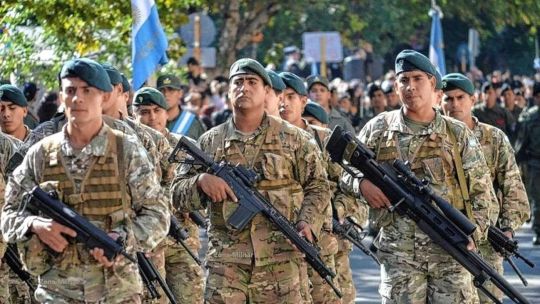
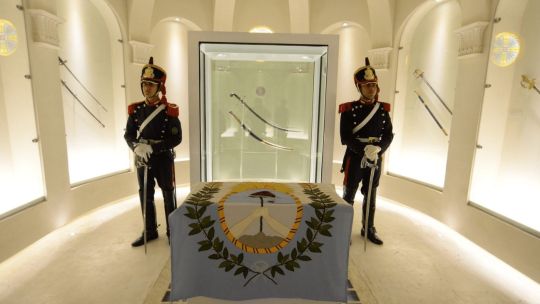
The transfer of the curved sabre of independence hero General José de San Martín from the National History Museum to the Granaderos a Caballo (Mounted Grenadiers) regiment was confirmed last Tuesday by publication of Decree 81/2026 in the Official Gazette, leading to a tempest in a teapot culminating in the resignation of the Museum’s director María Inés Rodríguez Aguilar the next day. The handover of the sabre, donated to the state in 1897, is due to be made in a ceremony today. The sabre had remained in regimental hands until a decree of then-president Cristina Fernández de Kirchner in 2015 transferred it to the National History Museum.
TRAIN STRIKE OFF
The Human Capital Ministry has resorted to compulsory conciliation to head off the train strike called for last Thursday. The train-drivers’ union La Fraternidad is now obliged to negotiate its wage claims for the next 15 days from last Wednesday before contemplating any further stoppage. The pay dispute has arisen from the government offering a two percent wage hike for last December when monthly inflation reached 2.8 percent.
‘FAKE NEWS’ GIVEN ANTIDOTE
The goverment has launched its "Oficina de Respuesta Oficial" to give rapid response to what it considers to be "fake news" while exposing alleged manoeuvres by the media and the opposition or "the political caste" in the words of the communiqué. The Office aims at correcting misinformation by providing more information rather than censorship, which it attributes to "political sectors linked to the left” since "freedom of expression is sacred for this administration," concluding: "Democracy is not boosted when lies are tolerated but when they are exposed."
GOOD LUCK WITH THAT
An Argentine court headed by federal judge Sebastián Ramos last Wednesday issued letters rogatory to request the extradition of former Venezuelan dictator Nicolás Maduro from the United States in order to try him in Argentina on charges of crimes against humanity, appealing to the 1997 treaty of extradition between Argentina and the United States. In other news concerning Venezuela, the Argentine most recently detained by the Bolivarian régime was also the first to be released – Gustavo Rivara (52) was freed from the notorious Helicoide prison in Caracas, where he had been held since May, and promptly crossed the frontier to Colombia, it was confirmed last Monday. On Wednesday another release dating back a fortnight was confirmed – Argentine citizen Roberto Baldo and his wife Montserrat Espinosa de Baldo (of Spanish and Venezuelan nationality), who had run a well-known pizza parlour in Caracas until detained in November, 2024.
WEATHERMAN REHIRED
The government last Monday reappointed 1982 South Atlantic war veteran Antonio Mauad as director of the Weather Bureau (SMN in its Spanish acronym) for the next four years after he had vacated the post last August following criticisms of his technical aptitude but minus a salary this time round, working ad honorem. The change in the Defence Ministry, with Lieutenant-General Carlos Presti replacing the civilian Luis Petri, is thought to have been decisive in his return.
GRAMMY GOES ARGENTINE
Argentine trap rappers Ca7riel and Paco Amoroso won the Grammy award for the Best Alternative Latin Album at last Sunday’s ceremony. Upon receiving the award, Paco Amoroso said: “We are very grateful for this opportunity. To our family, to our team, to Argentina and to all Latin America, we love you.”
THE PASSION OF LESS MULTITUDES
The traditional boast of Boca Juniors football club that it represents “half plus one” of the country has lost statistical force after an AFA Argentine Football Association report revealed that in the course of 2025 it lost one member out of every eight or over 41,000, dropping from a total membership of 323,853 to 282,644 and falling behind arch-rivals River Plate.
SAVED BY THE FBI
Thanks to the classified information from the Federal Bureau of Investigation (FBI) in the United States, school massacres in places as far apart as La Qiaca (Jujuy) on the Bolivian border and Miramar on the Atlantic coast were averted last Tuesday after the FBI warned of picking up anti-Semitic hate messages on the social networks. An undisclosed number of unidentified under-aged adolescents were arrested as a consequence.
MORE ORGAN DONORS
The donation of organs increased 92 percent in the province of Córdoba last year, permitting 113 operations as against 98 in 2024 with 50 of the transplants involving eye tissue. The beneficiaries included 25 children.












Comments