

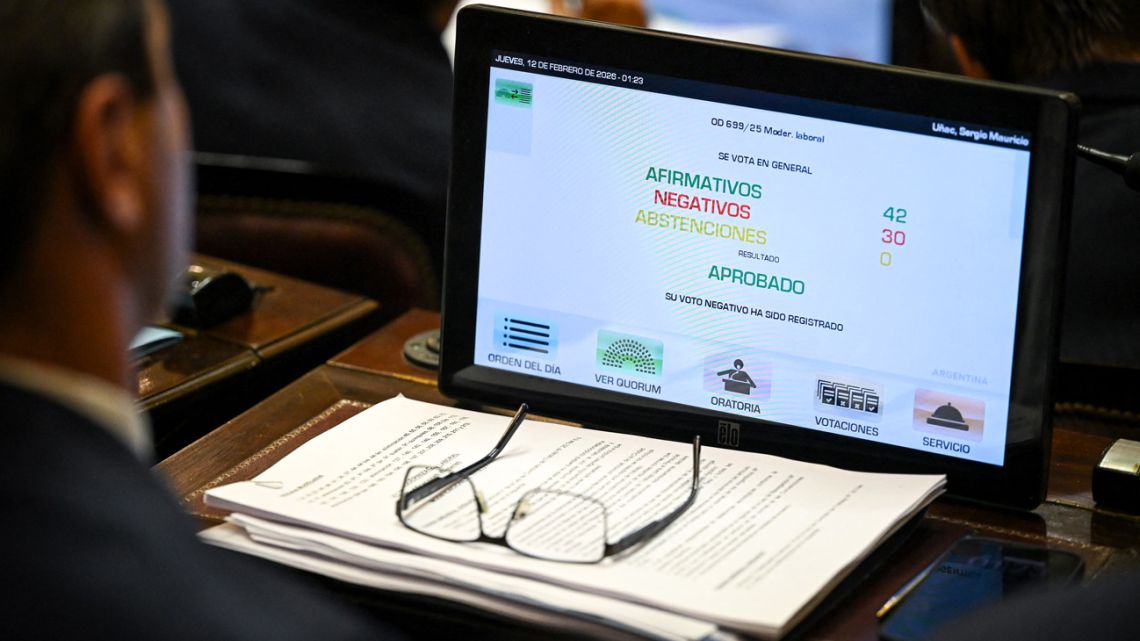
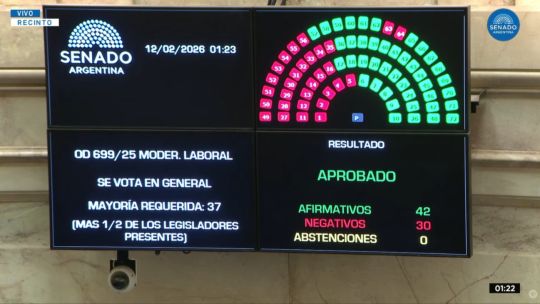
President Javier Milei’s government has secured a resounding victory in the Senate with the approval, by 42 votes to 30, of its flagship labour modernisation reform bill.
The bill and its accompanying amendments will now be sent to the lower house Chamber of Deputies, which can still review its text. The ruling party wants to put the reforms to a vote before February 27, according to congressional sources, with approval before normal sessions in March.
President Milei celebrated La Libertad Avanza’s clear victory, hailing it on social media as “historic.”
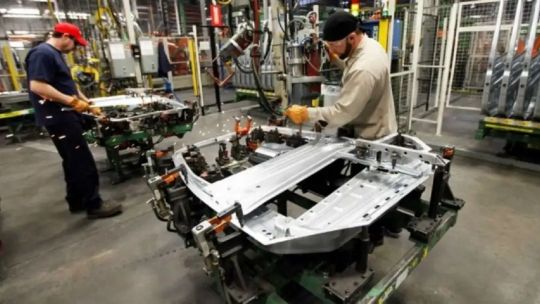
His government secured 42 votes backing for its initiative, which opponents and union leaders have branded “regressive.” The Casa Rosada says its reforms, which it considers long-overdue, will jumpstart the economy and lead to the creation of new jobs.

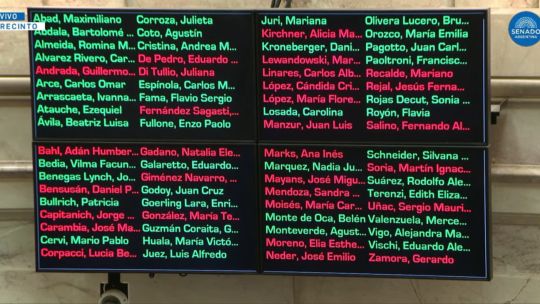
Along with 20 from La Libertad Avanza, it won the support of 10 senators from the Unión Cívica Radical (UCR), three from PRO, two from the Frente Social de la Concordia, two from Provincias Unidas and single votes from the Independencia, Despierta Chubut, Primero los Salteños, Frente Cívico and La Neuquinidad caucuses.
Support from provincial governors was key. These included senators representing the governors of Salta (Gustavo Sáenz), Tucumán (Osvaldo Jaldo), Chubut (Ignacio Torres), Neuquén (Rolando Figueroa), Corrientes (Juan Pablo Valdés), Córdoba (Martín Llaryora) and Misiones (Hugo Passalacqua).
An insufficient 30 votes were cast against by a cross-party group of mostly Peronist senators (Partido Justicialista, Convicción Federal, Frente Cívica de Santiago del Estero). Two more came from senators from Santa Cruz Province.

As the Senate’s marathon session moved towards the crucial vote, around 1am on Thursday morning, several ruling party leaders appeared on the balconies of the Senate to witness the final vote. Among them, Presidential Chief-of-Staff Karina Milei, Cabinet Chief Manuel Adorni, Lower House Speaker Martín Menem and Interior Minister Diego Santilli, who oversaw negotiations with provincial governors.
After granting general approval, senators reviewed clauses and amendments line-by-line. The ruling party did not accept proposals from various Peronist senators.
‘Turning point’
In a statement issued after Senate approval, Milei’s administration described its labour reforms as “turning point in history” that would deliver a “profound transformation that restores predictability, dynamism and freedom to the labour market”.
“The Office of the President celebrates the initial approval granted today by the National Senate to the Labour Modernisation Bill, a structural reform aimed at updating a system that for decades has pushed millions of Argentines out of formal employment and hindered the creation of registered jobs in our country,” the statement read.
“This law represents a turning point in Argentina’s labour history. After years of labour litigation benefiting a few, excessive bureaucracy and outdated regulations in the face of profound economic and technological change, we are now facing a deep transformation that restores predictability, dynamism and freedom to the labour market. The Argentina of litigation culture is nearing its end,” it continued.
The bill promoted by the ruling party includes tax-reduction incentives to encourage non-registered workers to enter into formal employment, caps on redundancy payments, the introduction of company-wide collective-bargaining agreements and limits on the right to strike for workers in essential services.
Opposition Peronist Senator José Mayans led the rejection of the bill in Congress, stating that it amended 41 existing laws and should not be dealt with in a single day. He denounced it as “unconstitutional.”
During her contribution to debate, La Libertad Avanza caucus leader Patricia Bullrich argued the bill would eliminate “obsolete legislation” that keeps the country “anchored in the past.”
Bullrich, one of its main backers, said the reforms would energise the private sector.
In comments to a local radio station Thursday, she denied claims it would destroy jobs or businesses. “It is a very important, very good law that creates a balance that until now we did not have” between companies and workers, she told Radio Rivadavia.
UCR Senator Carolina Losada agreed that the labour modernisation bill would bring “more investment, more companies and better pensions.”
“With this bill there will be more investment and more companies. And if we increase the number of people in formal employment, the pool of funds to improve pensions will also grow. All this thanks to a reasonable framework – and for many, what is reasonable is far from what they are used to discussing,” she said.
– TIMES/NA/PERFIL












Comments