

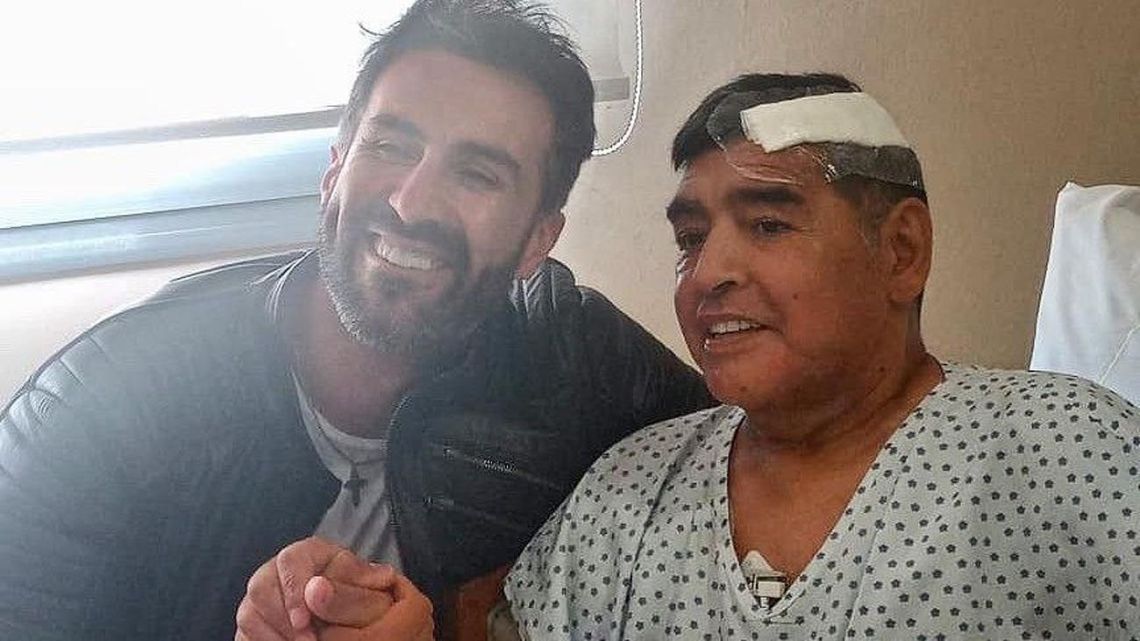
Diego Maradona repeatedly removed his IV line and placed the medical team under severe pressure in the weeks leading up to his death after undergoing head surgery, a former medical director told a court in Argentina on Tuesday.
Pablo Dimitroff, the former medical director of Clínica Olivos insitution where Maradona underwent surgery on November 3, 2020, said the institution had advised against home hospitalisation and proposed transferring him to a neurological and physical rehabilitation centre capable of supervising his recovery and substance dependency issues.
However, the football star was moved to a house in the northern outskirts of Buenos Aires, where he died 22 days later.
After the operation, the medical team began “having problems getting [Maradona] to understand that he had to remain still," Dimitroff said while giving evidence as a witness in the trial into the late footballer’s death.

“That’s when other problems began, which Dr Cosachov initially attributed to alcohol withdrawal,” he added, referring to psychiatrist Agustina Cosachov, one of the defendants.
“Until the end of his stay in hospital, on the 11th [of November], that was what kept us under constant strain. There were times when it was difficult to keep the patient under control; he removed his IV line several times, and we had to administer sedative and anticonvulsant medication in significant doses,” said Dimitroff.
The doctor said that it had been necessary to restrain the former footballer on occasion.

“Given this situation, and the need for physical rehabilitation and supervised treatment for substance dependency issues, it seemed that the appropriate place for him to continue treatment was not at home,” added Dimitroff.
The trial is examining both the appropriateness and the conditions of the home hospitalisation that ended with the death of Maradona at the age of 60 from cardiorespiratory arrest and pulmonary oedema.
According to Dimitroff, despite the clinic’s recommendations, Maradona’s entourage decided to move him to a rented house in Tigre, north of Buenos Aires, believing that he would not accept any other alternative.

Earlier in the day, neurosurgeon Pablo Rubino – who took part in the operation – testified that there had been more than enough reasons to justify surgery on a subdural haematoma, a build-up of blood between the brain and the dura mater.
Rubino said it had been preferable to operate preventively rather than risk having to carry out emergency surgery later, insisting that the procedure had been necessary.
He testified that Maradona had arrived from a clinic in La Plata “somewhat disoriented,” but said he recovered well after surgery despite displaying some withdrawal symptoms.

The late footballer was later discharged in good condition with no apparent cardiac issues.
Psychiatrist Ana Marcela Campos Waisman, who had been appointed by Swiss Medical to supervise Maradona’s medication, described Cosachov’s mental health treatment as “appropriate” and said the prescribed medication was consistent with toxicology reports from blood and urine tests.
She also said coordination between Cosachov and psychologist Carlos Díaz formed part of an interdisciplinary approach to treatment.

Hearings are being held in San Isidro after an earlier trial process was annulled last year.
The seven defendants face charges of homicide committed with awareness of the risk of death and could face sentences of up to 25 years in prison.
– TIMES/AFP/NA



Comments