

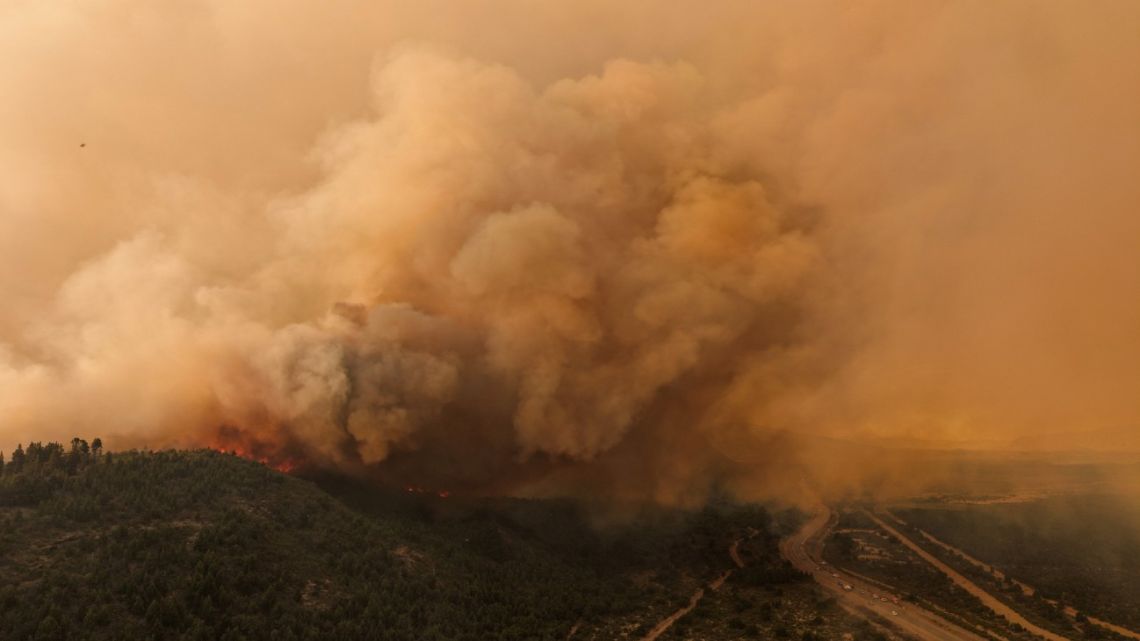
Forest and wildfires like those burning in Patagonia, where over 60,000 hectares have been ravaged by flames, will be increasingly more voracious, more frequent and more difficult to extinguish, an expert researcher warns.
The impact of heatwaves, desertification and population increase have sparked a profound change of the ecosystem, explained Thomas Kitzberger, a biologist and researcher at Argentina’s CONICET national scientific research council.
That was the assessment given to AFP by Kitzberger, who for four decades has studied the origins and impact of what he describes as “a new normal” to which humans, like nature, must adapt.
Has the pattern of fires changed?
Under normal conditions, these forests are not very flammable because of their high humidity content. But we’ve been experiencing a change which impacts the fire regime, with annual burned areas rising from thousands of hectares to tens of thousands. Over the past 20 years, the number of hectares burned has increased tenfold, so we’re already entering a new normal in which more than 10,000 hectares burn every year.
We attribute this to a multi-causality: we’re going through a period with more recurrent heatwaves with a a 50-year trend towards desertification and reduction of winter rain, which makes the vegetation reach the summer with a water deficit and more prone to fires.
What should we expect in the next few years?
Climate models indicate that by the end of this century, Patagonia will warm by between two and four degrees [Celsius], depending on scenarios of greenhouse gas emissions and precipitation will decrease by 20 percent. Those models are already being confirmed – almost every year we are breaking temperature records. By the end of the century, the probability of fires will be multiplied between fourfold and sevenfold.
What’s the impact on natural regeneration?
The decrease in forested areas and their replacement with scrubland. There is significant environmental degradation, in addition to economic and social changes, because tourist services associated with the forest will suffer losses.
Over the next few years, practically half the Los Alerces National Park – with some 260,000 hectares in all –will not be fit for tourism due to the degradation of the landscape. This is incompatible with society’s expectations, who have always considered this region pristine.
Is the region more vulnerable now?
Yes. There is a conversion from forest to scrubland, a more flammable ecosystem – a kind of positive feedback loop.We also see losses of high-altitude forests, lenga beech forests (native) which due to their natural humidity do not spread fire, but being affected by droughts we’ve been seeing over the last few years, they do burn. Degradation is very strong because climate conditions don’t favour their regeneration.
An adult alerce (Patagonian cypress, or "Patagonian larch") tree – between 500 and 1,000 years old – is fire-resistant because its bark is very tough, but young trees do burn. If the frequency of fires increases, alerce forests will regenerate less and less.
Pines were introduced in the 1960s for forest development, but it ended up being a trap for the life of the forest ... They will end up dominating the landscape, which will become ever more flammable.
How much of the fire activity is natural and how much is human?
There are more thunderstorms in the region with little precipitation because they occur during the dry season. This creates a high probability of fires caused by lightning strikes, often in hard-to-reach areas. The lack of early intervention makes them uncontrollable and for firefighters to be overwhelmed, as is the case now, where we see there is little they can do – only mitigate the damage, care for human lives and homes. They’re waiting for the rain or to be able to divert the flames.
At the same time, strong population growth in forested areas means many new residents are not sufficiently aware of the risks, with no education on prevention with pruning to reduce biomass.
This year we have two major fires, one natural and one deliberately set, but both became large, which means regardless of the cause, we have a problem.
Why are they so difficult to extinguish?
They spread underground through roots. They are hard to fight because they are invisible, latent fires that, when atmospheric conditions allow, reignite at the surface. Fire guards come in when the fire has already burned the tops and may have underground activity. This is a process which can last months, until autumn when heavy rain comes.
Patagonia is under some sort of curse. All human and climate indicators point to the fact that these phenomena will become larger, more severe and more frequent.
related news


by Sonia Avalos, AFP











Comments