

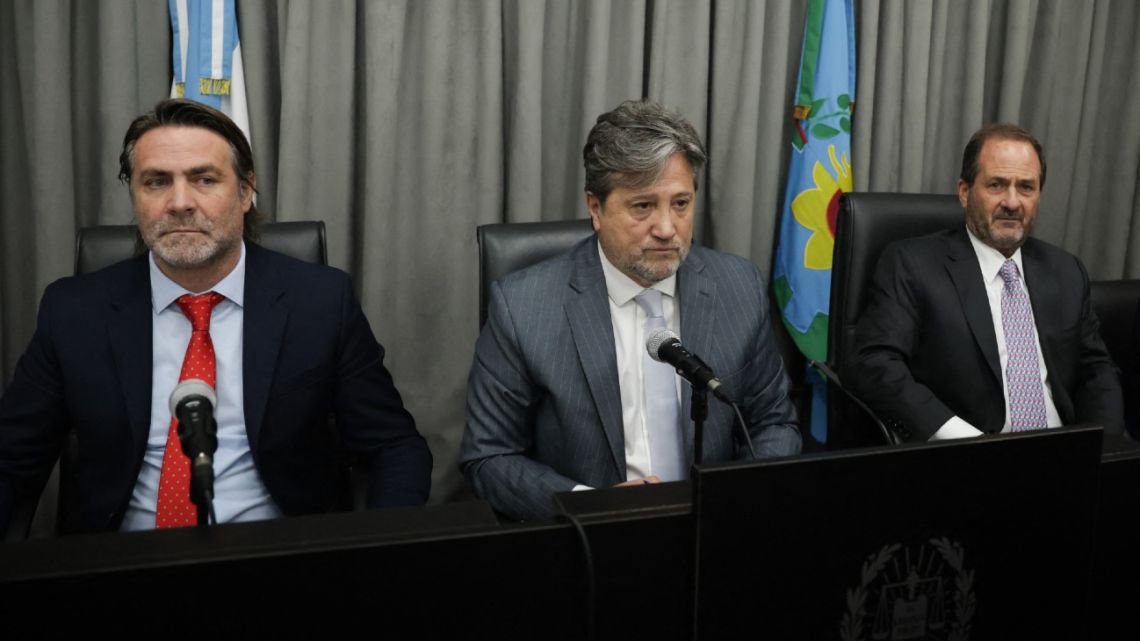
The verdict in the trial over the 2020 death of national football legend Diego Maradona will be delivered on December 22, a court announced Thursday, after six months of hearings and closing arguments.
The trial of seven healthcare professionals accused of negligence in the star's death concluded Thursday with statements from Maradona's daughter and several defendants.
The verdict and any sentences will be announced at noon local time on December 22, presiding judge Alberto Gaig said, becoming emotional as he closed proceedings.
"I hope my father receives the justice he deserves, like anyone else," said Dalma Maradona, the footballer's eldest daughter, her voice breaking with emotion.

The main defendant, Leopoldo Luque, Maradona's personal doctor in the final years of his life, reaffirmed his innocence and expressed his grief over the death. "I am innocent," he told the court. "It hurt me, and it will always hurt me."
Maradona died aged 60 on November 25, 2020, from cardiorespiratory arrest and pulmonary oedema. He was recovering from neurosurgery at a rented private residence in Tigre, north of Buenos Aires, where he was receiving home-based medical care.
His death plunged Argentina into mourning in the midst of the Covid-19 pandemic. Huge crowds of fans ignored social distancing rules to pay tribute to the legend at the Casa Rosada presidential palace
Physician cleared
The trial, which began in April, comprised 51 hearings and testimony from more than 70 witnesses.
Prosecutors sought prison sentences ranging from four to 12 years for six of the seven defendants, who face charges of homicide with dolo eventual, a legal category applying when defendants are alleged to have been aware that their actions or omissions could lead to death.
The prosecution requested 12 years for Luque, 10 for medical coordinator Nancy Forlini and eight for psychiatrist Agustina Cosachov.
The prosecution sought the acquittal of the seventh defendant, clinical physician Pedro Di Spagna.
With no accusation against him maintained by the parties, Gaig announced his acquittal on Thursday.
'Scapegoat'
In closing arguments on Wednesday, Luque's defence lawyers rejected the prosecution's claim that Maradona's death was foreseeable, describing their client as a "scapegoat."
They argued that Luque did not control the day-to-day care provided at the residence and that the footballer had died from a sudden, unpredictable cardiac event.
Throughout the trial, Luque was by far the most combative defendant, speaking several times when he felt he was being implicated. His legal team played audio recordings, presented scientific articles and even showed a video of Maradona's autopsy, provoking anger among the footballer's daughters.
"It's easy to attack me because I'm the one who had the most contact with Maradona," Luque said in court, adding that "the only one who would defend me would be Diego".
"I cared deeply for him, I loved him, he was my idol and my friend," he said.
Defence arguments
Cosachov's defence argued that a private healthcare company had withheld crucial information about Maradona's condition, including episodes of tachycardia and high blood pressure.
Her lawyer, Vadim Mischanchuk, said the psychiatrist had not been indifferent to warning signs and had taken steps to address them as they emerged.
Forlini, meanwhile, was accused of failing to ensure basic medical equipment was available at the residence. Her defence countered that she was responsible for providing services and equipment requested by the treating doctors, Luque and Cosachov, who had allegedly made no such requests.
On Thursday, lawyers for nursing coordinator Mariano Perroni and nurse Ricardo Almirón also sought their clients' acquittal.
Prosecutors accused Perroni of failing to provide medical summaries to nursing staff and properly supervise those on duty.
His lawyer, Martín Montalto, said there had been no omission or breach of duty by his client that contributed to Maradona's death.
Negligence claims
Almirón was accused of failing to take the footballer's vital signs correctly. His lawyer, Franco Chiarelli, argued that his client had completed most of the 23 reports recorded during Maradona's home-based treatment.
The central question in the case is whether the decision to allow Maradona to recover at home rather than in hospital amounted to negligence.
Prosecutors pointed to the near-total absence of medical equipment, including a hospital bed and defibrillator, and the lack of a readily available ambulance as evidence of failures in his care.
Medical experts testified that those responsible for Maradona's treatment had failed to respond adequately to warning signs in the days before his death, including oedema, tachycardia and breathing difficulties.
– TIMES/AFP



Comments