

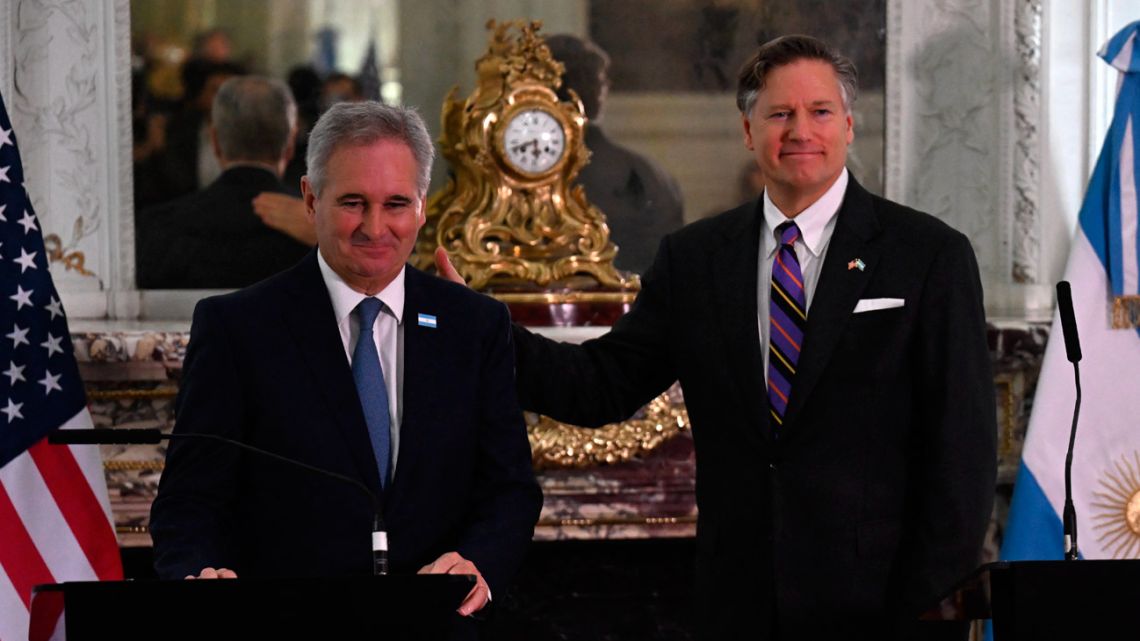
“There is no other country in the world with which we are more closely aligned.” With those words, Christopher Landau, US Deputy Secretary of State and the second-highest-ranking official at the US State Department after Marco Rubio, on Thursday summed up the current state of relations between Donald Trump’s administration and Javier Milei’s government.
Landau made the remarks at a joint press conference after a meeting at the San Martín Palace with Argentina’s Foreign Minister Pablo Quirno. Juan Pablo Segura, the US official responsible for Western Hemisphere Affairs, also attended. This is the highest-ranking visit from Washington since Trump returned to the White House.
Quirno put security at the heart of his message, framing it within the Shield of the Americas, the hemispheric initiative being promoted by the United States. “We are working with the United States: we are pooling our capabilities to prevent criminal organisations and drug-trafficking networks from operating,” he said. “The threat facing one country compromises everyone’s security.”
In keeping with the position the Milei administration has maintained at international forums, the Foreign Minister stressed that “Argentina calls terrorism by its name.”

The announcement was accompanied by figures. According to Quirno, the US government has approved US$13 million to combat drug-trafficking, of which US$7 million would go to Argentina. In addition, the National Security Ministry, headed by Alejandra Monteoliva, has signed a US$10-million agreement aimed at strengthening efforts to prosecute those involved in child-trafficking. A further US$15 million will go towards establishing a cybersecurity operations centre that will make it possible to “monitor and protect our networks,” said Quirno. The project also includes an assessment of the network operated by state-owned telecommunications company ARSAT.
Argentina’s Foreign Minister linked the security agenda to the economy. “Security has an economic dimension,” he said, presenting the visit as a continuation of the work undertaken with US Trade Representative Jamieson Greer, with whom Argentina signed a reciprocal trade and investment agreement. Qurino also mentioned the memorandum on critical minerals, one of the main areas of interest for Washington in the region, and stated that “co-operation with the United States creates new opportunities for employment and investment.”
At that point, Quirno made a reference that did not go unnoticed: “Our integration requires secure routes. That is why preserving peace and stability in the South Atlantic is a strategic priority on our agenda, in order to protect these flows from interference or disruption.” The remark comes at a sensitive time, following suggestions from the White House that the UN Special Committee on Decolonisation (C-24) should be disbanded. The committee is the forum where Argentina reiterates its sovereignty claim over the Malvinas (Falkland) Islands each year.

Quirno avoided naming the islands, opting instead for the language of secure trade routes, which is more closely aligned with Washington’s priorities. “We are a fundamental pillar of prosperity in the Americas,” he argued.
One of the announcements likely to have the greatest public impact concerned progress towards joining the US visa waiver programme, an ambition the government has pursued since taking office. Membership would allow Argentines to travel to the United States without having to apply for a visa. Quirno gave no indication of a timetable.
The high-level US visit extended beyond the Foreign Ministry. Landau and Segura were scheduled to meet Fernando Brun, Argentina’s secretary for international economic Relations, who is responsible for trade negotiations with the United States, as well as Economy Minister Luis Caputo, Justice Minister Juan Bautista Mahiques and Monteoliva.

On Friday, Milei was due to receive them at the Casa Rosada on his return from Spain. Before arriving in Buenos Aires, the delegation visited Paraguay, where it announced US$5.5 million in assistance to combat terrorist financing.
The tour is underpinned by a more ambitious economic promise. US Ambassador Peter Lamelas, who accompanied the officials, had announced that US agencies could mobilise up to US$20 billion in investment and financing by the end of 2027, primarily in energy and infrastructure. The official statement on the visit refers to promoting growth and security co-operation by making use of the Andes–Atlantic Corridor, while Segura highlighted the agreement with state oil firmYPF.
Underlying all this is the rivalry with China over influence in the region, which informs every move Washington makes towards Buenos Aires. The backgrounds of the envoys reflect this approach: Landau, a former ambassador to Mexico, views foreign policy through the lens of economic relations; Segura, a businessman and former Virginia Secretary of Commerce, is an outspoken anti-communist who argues that “one of the most powerful tools the United States has is its economic power.”

The visit also serves as a prelude to the arrival of Vice-President JD Vance, which is expected in November, although no official date has yet been confirmed.




Comments