

Few rituals carry as much emotional weight – or as much everyday presence – in Argentina as the act of sharing mate.
Present in approximately 90 percent of all Argentine households, according to the Instituto Nacional de la Yerba Mate (INYM, National Institute of Yerba Mate), each Argentine gets through an average 6.4 kilos of yerba each year.
Though today it is a symbol of national identity in Argentina, the origins of yerba mate stretch back to the Guaraní people, who consumed the leaves of Ilex paraguariensis as a communal stimulant and spiritual connector.
Later adopted and expanded by Jesuit missions, mate evolved into a vehicle of socialisation and companionship across the Río de la Plata region.

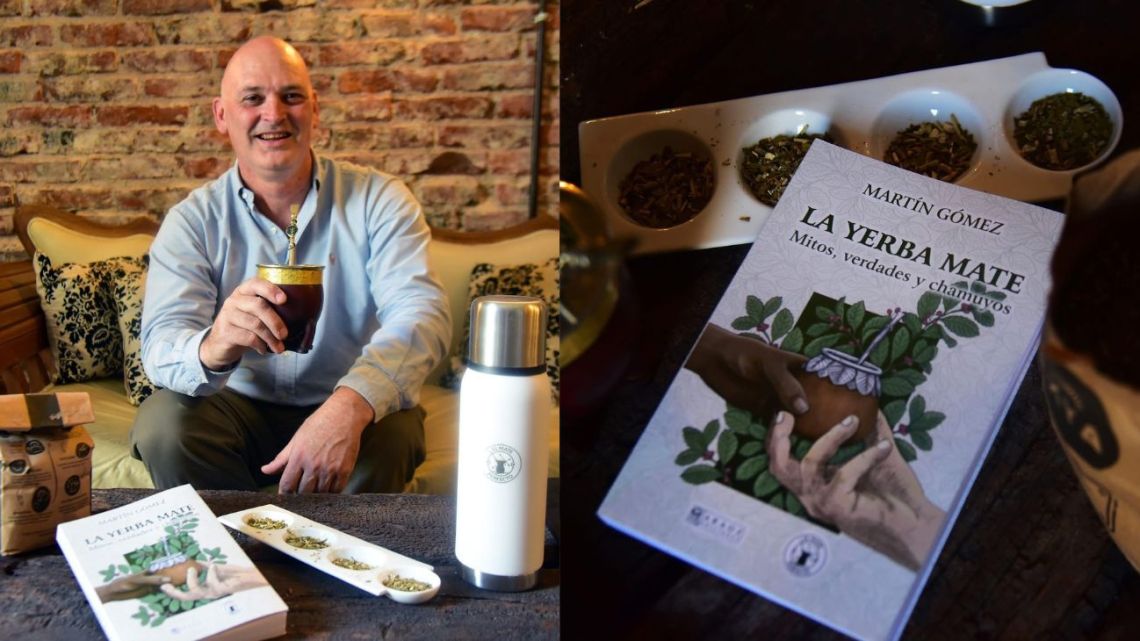
Few people understand the history behind the drink better than Martín Gómez, a chemical engineer turned yerba mate sommelier and the creator of the ‘El Mate Perfecto’ social media account.
Gómez has investigated long-held assumptions about mate, conducted his own experiments during the pandemic and eventually created an entirely new professional category within the world of sommellerie.
Through meticulous testing, sensory evaluation, and a deep respect for mate’s ancestral roots, the expert has become one of the most compelling contemporary voices on how we drink mate, why we drink it and how its consumption is evolving.

His recently published book, Yerba Mate: Mitos, Verdades y Chamullos, challenges myths, expands historical narratives, and invites readers – experts and novices alike – to think more critically and more curiously about a drink they may take for granted.
In an interview, Gómez reflects on his unusual path to becoming an expert, the idea behind “the perfect mate,” how the pandemic reshaped consumption habits and where he believes yerba mate is headed globally – from canned infusions in the United States to a growing community of experimental drinkers in South America.
As yerba is expanding beyond the Río de la Plata and into new global markets, Gómez stands at a cultural crossroads, translating centuries of tradition into contemporary language.
As for anyone just beginning their own journey with yerba mate, Gómez offers the simplest and most generous advice: jump in, stay curious, and enjoy the search. The perfect mate is the one you discover for yourself, he says.
How did your relationship with mate begin? Was there a moment or experience that led you to study it beyond everyday habits?
My curiosity around mate initially began at a university of chemical engineering. It started in an organic chemistry lab, where a professor told me that the optimal extraction temperature was 68 degrees – from there I started to get curious about what was going on with mate.
Later, during the pandemic, I began to experiment with things I had at home – ice-cream tubs, mosquito nets, mesh, placemats, things I could use as filters and scales. I started researching aspects that I felt hadn’t really been studied. I kept hearing the same claims repeated, and from my research I felt they didn’t always make sense, so I began to investigate.
After that I started writing about these things, then I trained as a professional sommelier and began to specialise in mate within the world of sommellerie as well, and I ended up creating the role of “yerba mate sommelier.”
From there I was able to start discovering what, in the end, is something we drink a lot in South America but that is becoming more and more in demand worldwide. At the same time, I believe that, with all the new needs that exist, it requires a different kind of specialisation. That’s why I think today a sommelier makes sense.
When you always drink from the same gourd, with the same bombilla, the same yerba, the same kettle, nothing special happens. But when you start to add complexity and options, the market needs someone who can build that bridge. That’s what I say the sommelier does.
How would you explain el mate perfecto, your brand – the perfect mate that’s built on all this science?
Precisely, “the perfect mate” is an imaginatory ideal. It’s not something real. When you look at my logo, it has the Southern Cross, because I believe that with the perfect mate, the most important thing is the journey, the process, the search for something unattainable as part of a ritual and a personal quest.
Along that path you discover things, you discover people, you connect with others. So I always say: the perfect mate is really the one that belongs to each person. What’s beautiful about it, and how the project began, is the idea of valuing the experience and the journey more than the technical knowledge of what that perfect mate is. Because, as I say, it either doesn’t exist or it’s different for each person. In the end it’s more of an unreachable ideal than something concrete.
How did our way of drinking mate change after the pandemic?
I think the most important thing that happened with the pandemic is that, as with many aspects of life, it transformed our daily routines. In the case of mate, because we were forced to have our own individual mate, more types of gourds and more kinds of yerba began to appear in each family or group of friends.
For the yerba mate market, that opened a door for many different presentations and new ways of consuming it. I interact with many people who, during the pandemic, discovered a kind of yerba, a blend, a preparation method or a new brand, helped by the fact that the pandemic accelerated digitalisation and logistics. Many small producers were suddenly able to reach consumers directly. A lot of people discovered a yerba they liked, and by having to prepare their own mate in the way they liked best, they became more attached to yerba mate.
Now you see that where before there was one mate in a household, there are two; where there were two, now there are three, and so on. If you add to that the media boom around mate – especially through athletes, who have introduced many young people to the habit – I think what we’re seeing is that mate culture has expanded significantly in the post-pandemic period.
The brand Guayakí is now selling canned yerba mate drinks in the United States. What do you think of that model?
I think Guayakí, like many other brands abroad, quickly understood that the benefits of yerba mate justified developing products so that new consumers could access those benefits in the way they most enjoy – whether that’s in a carbonated drink or a static infusion, and not necessarily in the traditional gourd.
I believe the future of yerba mate, in terms of global expansion, is more tied to our capacity to understand these new ways of consuming it than to creating new yerbas. The main challenge for producers is to understand these new forms of consumption.
I think global demand will push those of us who promote and work with yerba mate to be more creative so we can insert ourselves and compete in spaces that traditionally didn’t belong to yerba mate.
What advice would you give to someone who is just starting to drink mate and wants to know how to do it properly? What do they need to know?
First, they should dare to drink mate even if they don’t know everything yet – there is no such thing as an “incorrect” mate! That’s the first point.
Then, as with many other drinks, especially bitter ones, it’s something you have to get used to. So in general I recommend looking for what I call coarse-ground yerbas, without stems. If it still feels too intense, you might mix in another herbal tea – something that reminds you more of a classic infusion like chamomile, mint or another herb – so that the experience feels closer to tea.
Start with lower water temperatures, and at the beginning, to keep things simple, use gourds made of stainless steel or wood so you don’t have problems with caring for the container.
But for me the most important thing is to jump into the adventure. And if someone doesn’t want to drink traditional mate, they can still just make an infusion: roughly three to six grams of yerba mate in a cup of water for about three minutes will give you a very good drink.













Comments