

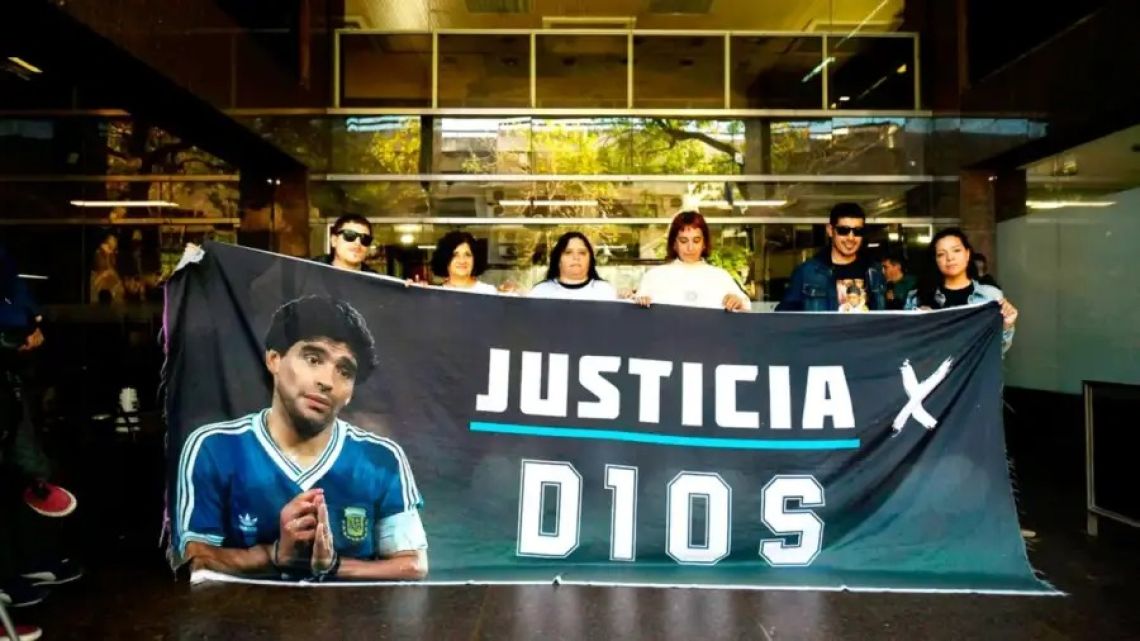
One of the doctors who carried out Diego Maradona’s autopsy told the trial into his 2020 death on Tuesday that the late football legend’s heart showed signs of prolonged agony.
“When we cut into the heart there were intracavitary clots. These clots appear in prolonged agonal periods,” doctor Federico Corasaniti said as he appeared via videolink at the opening of a new hearing in the trial, being held in San Isidro, outside of Buenos Aires.
That period of possible agony – lasting 12 hours or more, according to the expert’s classifications – is a sensitive issue in the case, which among other questions seeks to determine whether the star received proper care from the medical team responsible for him during home hospitalisation following an uncomplicated neurosurgery.
It is the second time the courts have attempted to clarify the circumstances of Maradona’s death. A first trial was annulled in 2025 when it emerged that one of the judges had been involved in the production of an unauthorised documentary about the case.

Seven of Maradona’s caregivers face prison terms of between eight and 25 years if convicted of homicide with possible malice aforethought (dolo eventual) – pursuing a course of action despite knowing it could lead to death. They could face sentences of up to 25 years in prison.
Corasaniti also said that during the autopsy he found Maradona’s abdomen “distended” and “swollen” due to a significant accumulation of fluid in the peritoneal region, caused by heart failure that “in no way” could have occurred suddenly.
Later, expert witness Silvana de Piero said the former footballer had “brain swelling” and a liver condition “compatible with cirrhosis” when he died of pulmonary oedema and cardiorespiratory arrest on November 25, 2020.

“We found swelling in the brain. In my view he was in a state of decompensation because he had oedema in the lungs and in the brain,” said De Piero, an anatomical pathologist who examined several of Maradona’s organs after the autopsy.
At the same hearing, forensic chemist Ezequiel Ventosi testified that he analysed Maradona’s blood, urine and swab samples after his death. He said there was no record of alcohol or drugs in the late footballer’s body.
“Analysis of the blood samples returned ‘not detected’ for drugs of abuse: cocaine, THC, amphetamines and MDMA,” Ventosi said.

In addition to the seven defendants in this case, one of the nurses who was due to care for the idol in his final 24 hours – the eighth accused – will be tried separately before a jury.
This second trial began in early April. Hearings are held on Tuesdays and Thursdays and are expected to continue at least until the second half of July.
Around 120 witnesses have been called to testify.
related news

by Martín Raschinsky, AFP






Comments