

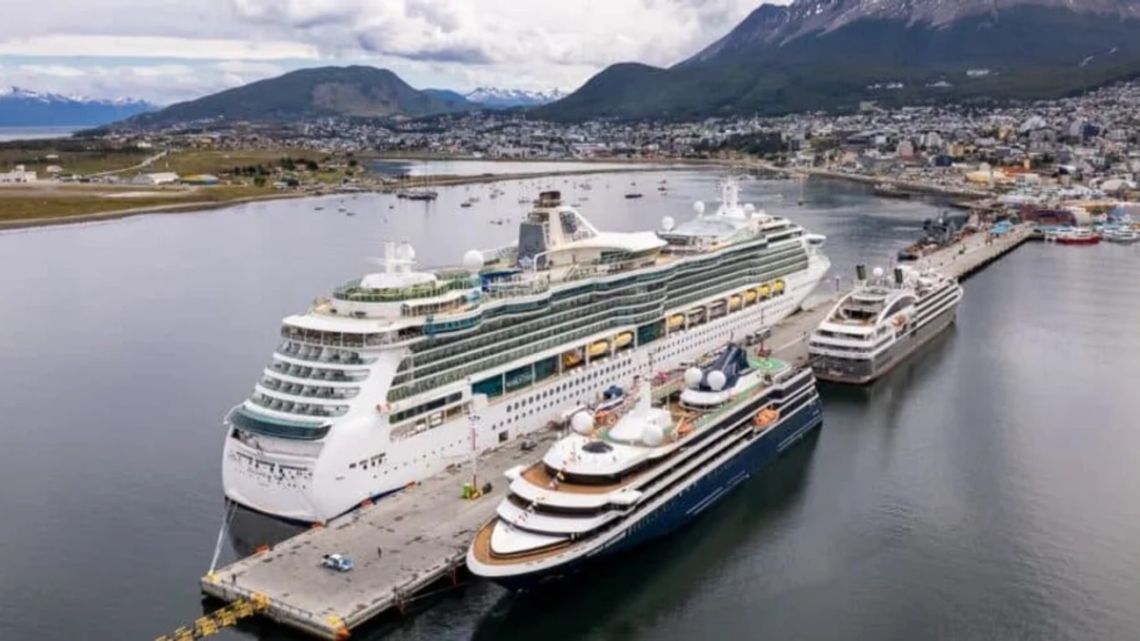
Argentina’s government has ordered a 12-month administrative intervention at the Port of Ushuaia, citing financial irregularities and serious shortcomings in port infrastructure.
The National Agency for Ports and Navigation (ANPyN) suspended the operating licence of the Port of Ushuaia after detecting irregularities in the management of funds and ordered an administrative intervention at the terminal, according to the government.
It subsequently placed it under trusteeship.
The intervention sparked strong opposition from Tierra del Fuego Province Governor Gustavo Melella, who described the claims as unfounded. “There is no objective justification for a decision of this magnitude," said the Peronist governor.

In a statement, the ANPyN said it had formally instructed the provincial government to address a range of irregularities, including alleged diversion of funds and operational and safety risks linked to insufficient infrastructure investment.
“The decision was taken as a result of the lack of concrete responses to inspections carried out, complaints of asset stripping raised by workers, and concerns expressed by representatives of shipping companies operating at the port,” the agency said.
The resolution, signed by ANPyN executive director Iñaki Arreseygor, establishes that the port will be placed under trusteeship for one year. It was published on Thursday in the Official Gazette.

The measure was triggered by complaint challenging Provincial Law No. 1596, which created a fund to cover debts of the state-run health insurer OSEF using the Port of Ushuaia’s financial surplus.
The complaint was filed by Juan Avellaneda, secretary-general of the senior railway staff union, who has been appointed to oversee the port’s operational management under the supervision of ANPyN directors and senior officials, reported Noticias Argentinas.
ANPyN said inspections uncovered multiple infrastructure failures and deficiencies, along with serious shortcomings in administrative and financial management, as well as basic operational safety conditions.

The agency said these issues were formally reported to the provincial authorities, alongside a demand for the creation of a transparent register of income, expenditure and procurement. That function, it noted, had been outsourced to a company whose registered business activities were unrelated to port services.
According to ANPyN, 33 percent of the port’s budget had been used to subsidise the provincial government accounts, in breach of regulations requiring port revenues to be reinvested exclusively in port infrastructure and operations.
As a result, just 1.3 percent of the budget was allocated to works and services aimed at improving operational quality.

Argentina’s naval Coast Guard (Prefectura Naval) will assist the intervention to strengthen safety conditions and support operational tasks at the port, the agency added.
The Port of Ushuaia is considered a strategic asset, due to its proximity to Antarctica and its status as one of the country's main cruise ports. Although it does not have the highest commercial volume, its role in international connectivity and tourism makes it sensitive both operationally and politically.
On Sunday, three days after the intervention, a United States Department of Defence aircraft landed at Malvinas Argentinas International Airport in Ushuaia.

The aircraft, a Boeing C-40 Clipper operated by the US Air Force, remained in Buenos Aires for two days before heading to the capital of Tierra del Fuego.
No Argentine or US official provided any explanation for the flight or the identity of the crew or passengers.
The aircraft is typically used for official visits by senior civilian or military officials.
– TIMES/NA/PERFIL









Comments