

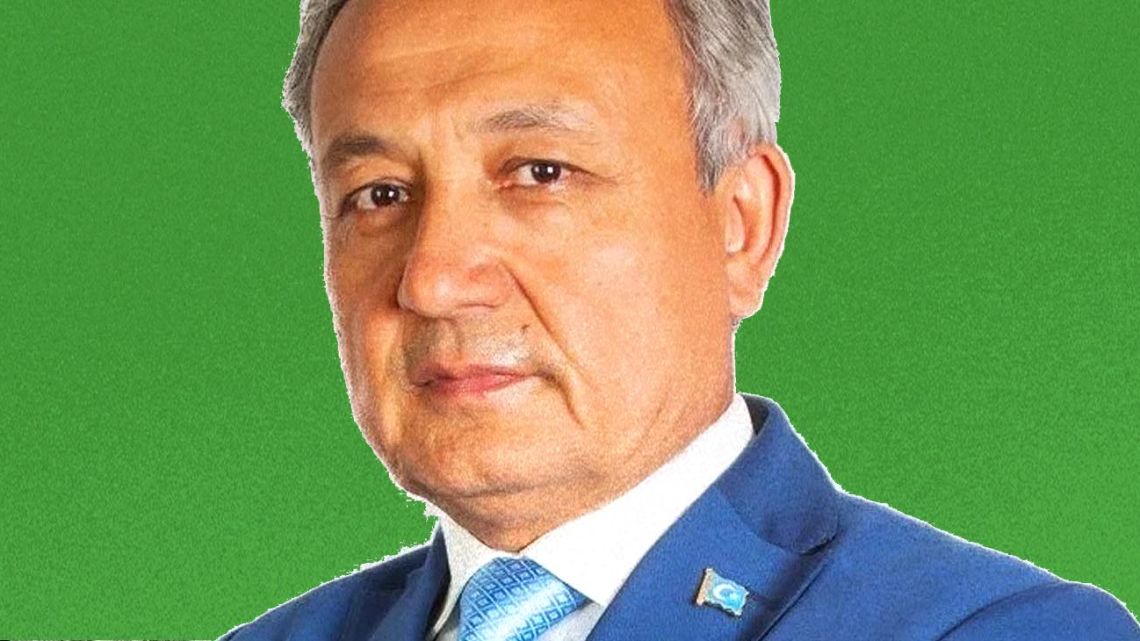
Dolkun Isa is one of the world’s most prominent Uyghur activists and a leading campaigner for the rights of minorities in China’s Xinjiang region.
Born in Aksu in 1967, Isa left China in 1994 and eventually settled in Germany, where he became one of the leading voices of the Uyghur diaspora. A former president of the World Uyghur Congress, he has spent decades campaigning to draw international attention to alleged rights abuses against Uyghurs and other Muslim minorities in China.
Now leading the World Centre for Democracy and Human Rights, Isa was in Buenos Aires last month for a human-rights conference and events linked to a landmark legal case seeking to investigate alleged genocide and crimes against humanity in Xinjiang through Argentina’s courts.
During his visit, an event at the Buenos Aires City Legislature at which he had been due to speak was cancelled and moved to another venue. Isa alleges the decision was the result of pressure exerted by China through diplomatic channels – part of what he describes as Beijing’s campaign of “transnational repression” against Uyghur activists living abroad.

“China is watching me all over the world, wanting to take me to China,” Isa told the Buenos Aires Times and Perfil in an interview last month before leaving Buenos Aires.
Beijing strongly rejects accusations of genocide and systematic repression in Xinjiang, saying its policies are designed to combat terrorism and religious extremism. Isa, however, argues that Beijing’s campaign against the Uyghurs has gone far beyond China’s borders. Argentina could now become an important battleground in efforts to hold Chinese officials accountable, he reveals.
In this interview, Isa discusses the allegations against China, his family’s experience, Beijing’s influence in Latin America and why he believes Argentina’s courts could offer one of the few remaining avenues for Uyghur victims seeking justice.
Let’s begin with the newsworthy. What is your understanding of why the event at the City Legislature was cancelled, and what do you think it says about freedom of speech?
My colleague and I are visiting Buenos Aires for several purposes. One important purpose was one of the Uyghur writers, whose name is Yalqun Rozi. He got an award, a human-rights award, the Graciela Fernández Meijide Award. So, because he is in jail – he is sentenced to 15 years – his family is living in the United States, but as they don’t have travel documents, that’s why me and my colleague … came to Buenos Aires to, on behalf of him, receive this award.
[Editor’s note: Rozi is serving a 15-year prison sentence in Xinjiang, China, for “inciting subversion of state power.”]
Besides this, we are also attending this human-rights conference, which is organised by [think tank] CADAL, and I was invited as one of the speakers for this. But the Chinese government tried to pressure [them] to stop this conference event, particularly to stop my participation.
It is not new for me, of course. It is not new because the Chinese government is monitoring and following all our activities, and [from] time to time, when we are travelling around the world, the Chinese government is trying similar attempts to stop us.
This is my fourth visit. My first visit to Buenos Aires [was] in 2022, because we submitted [a criminal complaint] for universal jurisdiction in Argentina courts. In 2023, another trip, and 2024, also another trip for universal jurisdiction.
Did you face pressures on those trips as well?
That time, no, we didn’t get any pressure. Of course, the Chinese government maybe did [try something], because I’m not surprised – the Chinese government, all the time, makes pressure – but [it was] not visible that time, and no event was cancelled, you know?
Even when I was on my first visit and the second and third visit, we had a meeting at [at the] Foreign Affairs [Ministry], Asia-Pacific division, and also [the] human-rights unit.
And were you able to meet with government officials this time during your visit?
Unfortunately, this time, before I was coming, my office was also trying to reach out to the Foreign Ministry to ask for an appointment to meet, but no answer.
Through CADAL, also trying to arrange a meeting with the Foreign Office, but they refused the meeting.
And what were you told about the cancellation of the event? What was the excuse given to you?
Well, actually, the Chinese Embassy didn’t give me any excuse, but just pressure to the Foreign Office, Foreign Ministry of Argentina, and Argentina’s Foreign Ministry, as I understand, [contacted] CADAL and pressure to the [Buenos Aires] City council and the venue and, just one week from the event, it was cancelled.
You feel that Chinese pressure extends beyond the borders of China towards you, regularly?
Yeah. The Chinese government all the time, you know – in 2023, we were travelling to Latin America, [an] advocacy trip, not only Buenos Aires, but São Paulo, Brazil, Costa Rica, Chile.
So, when we were travelling [in those] countries, [the] Chinese Embassy reached out. Even when we were having meetings at some universities, at the time, you know, and we had interviews [with] journalists.
For example, I remember very clearly in Brazil. One of the biggest newspapers had a long interview with me, and first [they prepared] the electronic version, and the Chinese Embassy called the editorial [desk]. Then they cancelled [it]. Didn’t publish. And, yeah, because “Dolkun is [a] terrorist or he’s a separatist,” [they said he] should not be published, his interview. And the newspaper editor said, “Okay, you have another opinion. Then you will write an op-ed, then we will publish it too.” Then the next day, the Chinese ambassador, he published another editorial, an op-ed.
And when we were in Chile, we had a meeting with professors at a university. The last time we came to Buenos Aires, we also had a meeting with students. Even the Chinese ambassador reached out to them, asking them to cancel this meeting.
Let’s talk about Xinjiang, which you call East Turkestan. We’re talking about northwestern China. For someone who has never been there, how would you describe the region?
It’s 1.6 million square kilometres. It’s a big territory, you know? One-sixth of the whole Chinese territory. And the majority living [there] are Uyghurs. We are Uyghurs. This was occupied by Communist China in 1949.
China calls it Xinjiang – Xinjiang is a Chinese name. “Xin” in Chinese language, “Xin” is “new,” “Jiang” is “border territory” – new territory, new border. But China claims all the time, “Oh, Xinjiang and also Tibet [are] part of China from ancient, ancient times.”
The Chinese government, since occupation in 1949, systematically [implemented an] assimilation and discrimination policy in this region. In 1949 … the Chinese population [was] around four to five percent, mostly military, or government officials, families and the like.
But since the occupation, since 1949, 1950, then systematically [they brought] population to this area and [diminished the Uyghur] population.
So that time, the Uyghur population [was] 85 percent total, [in] 1950, 1949. But now, according to official numbers – Chinese official numbers – Uyghur population is diminished from 85 percent to 42 percent …
2013, 2014, current President Xi Jinping took power, then this discrimination, assimilation policy changed dramatically into a genocidal policy.
This is, in 2014, the “Strike Hard” campaign. China says this has to do with eliminating terrorism and extremism. That’s what you consider to be a turning point?
Yes, it’s a turning point.[Then] This Chinese government [is pursuing] ethnic assimilation policy, ethnic cleansing policy.
Ethnic cleansing policy?
Yes.
This is a campaign that you have led – in terms of trying to hold the Chinese government to account – for quite a few years. Including your time previously at the World Uyghur Congress. When you are trying to present allegations of genocide and crimes against humanity in court, what evidence do you have for what happened in the camps and around religious repression?
Under Xi Jinping, the Chinese government took, from 2014, step by step, the assimilation and discrimination policy into the genocide policy. It was not implemented within one day – step by step.
Then China began testing. Because we are Muslim, Sunni Muslim, they forbade all religious activities. For example, fasting during Ramadan time – forbidden to be fasting – and they also collected all copies of the Quran.
They gave a deadline in 2015, Chinese government gave a deadline: anyone who keeps a Quran at home should bring it to the police station or local government. If they did not bring their Quran or any religious books, then later police would search their home, and if they found any religious book, then they would be punished.
Then people brought the books to the police station, but then they got a problem. The government officer would ask, “Did you practise religion? You read the Quran? You are praying?” They were questioning a lot.
Then people were afraid to bring the Quran, religious books and all these things.
Some Uyghurs kept the Quran. It doesn’t matter [whether they were] religious or not. [They kept] the Quran because at least we are Muslim, [it is] just a symbol, you know?
We raised this issue [at the] UN, and we were constantly attending [the] UN Human Rights Council, and several countries – no international organisation, and particularly Muslim countries… no reaction for us.
In August 2016 they collected all passports, then cancelled all international trips. And, yeah, also the Internet was cut. All communication was cut.
There was no serious reaction from the international community or Western countries. Just Human Rights Watch and Amnesty International published statements, that’s all.
Starting in 2016, they started sending people to the concentration camps. We estimate more than three million people [went] in the concentration camps.
At the UN in 2018, the Committee on the Elimination of Racial Discrimination reviewed the Chinese report. That time, UN experts exposed that more than one million Uyghurs, Kazakhs and other ethnic groups were in the so-called “re-education” camps.
Until that time, the Chinese government denied everything: “No, we don’t have such centres, no detention.”
But Human Rights Watch, Amnesty, the World Uyghur Congress and more than 20 international organisations made submissions – evidence, everything. And the UN experts reviewed China’s report. I was there too, in Geneva.
Then Chinese government could not continue hiding the reality, denying reality. They said, “Oh yes, we have a centre, but it is not a detention centre. It is not a concentration camp. It is a vocational training centre, where we educate the people for a better future.”
But so many professors, intellectuals, football players, singers, teenagers and pensioners have been in the camps – like my mother.
My mother also died in a concentration camp in 2018. She was a 78-year-old lady.
You say that your family has faced retribution for your activism.
Yes, yes. My last telephone communication with my family – my mother, my family, our entire family – was in the middle of April 2017.
Up to 14 months later, more than one year later, I got [news that] my mother passed away. Nearly three weeks later I got the news.
In 2022, I learned another heartbreaking news: my father passed away. I learned this also from Chinese media, but years have passed, and I still had no idea which day, which month, which year exactly, where, or in what condition. At home, hospital, concentration camp – I have no idea.
Even where his cemetery is, still I don’t know.
Then in 2021, I got another news from Radio Free Asia: my younger brother was sentenced to life.
Life in jail? Any charge in particular?
No. I don’t know.
And my older brother – he’s a mathematics professor – he was sentenced to 20 years.
This is all the news from the last nine years I got regarding my family. They are all my family. My mother and father were not activists like me. They are not politicians. They are very ordinary people. Only crime of my family members is their ethnicity as Uyghur, that’s all.
In my case, I am not unique. All my colleagues [have similar stories].
Let me put what the Chinese allegations are directly to you. I mean, they have called you a separatist. What exactly are your political objectives? Do you want an independent Uyghur state? Do you want greater autonomy? Do you want simply an end to discrimination?
China blames the Uyghur. China’s narrative changes all the time.
Before the September 11 terrorist attack in New York, China blamed the Uyghurs for separatism, for being traitors, for being religious fundamentalists.
And after that moment, it became “terrorism”?
Yeah. After September 11, the Chinese government – the United States started a war against terrorism, and China said, “Oh, it’s a perfect excuse.” Then immediately, overnight: “Oh, we are victims of terrorism.” Because we are Muslim, you know, it’s easy to condemn us as terrorists.
But there was terrorism in the region. There was unrest and a series of attacks. There were knife attacks and violence at the time.
Well, sometimes that was happening, of course, because injustice was happening and mass killings.
For example, on July 5, 2009, a very peaceful demonstration was taking place. Then the Chinese government killed – the official number – 173 people were killed in one day.
Then the Chinese government said a peaceful demonstration had turned into violence, and then they said: “This is a terrorist attack.”
What would you like to see in the region? What is the political future you want?
This is officially the Xinjiang autonomous region, but we have no autonomy.
Of course, before the Chinese Communist Party occupied this country, this was under a military Nationalist Chinese government. They controlled it. Then we fought, then we declared independence.
So this “autonomy” brought just mass killings of the Uyghurs, and persecution, intimidation, assimilation. And now this policy changed into a genocidal policy.
The World Uyghur Congress, as a Uyghur organisation, demands self-determination according to international law.
I’ll repeat the question. Do you think it’s fair to call yourself a separatist? Is it a fair label to give you?
For the Chinese government, [it is] separatist and terrorism…
China says 99 percent of Uyghurs are happy with the Chinese system and that only a tiny minority are separatists. If you trust that, ask yourself according to international law, which gives the right to self-determination – like Scotland or Quebec.
Let’s move to the international response. Do you feel there is less international support for the Uyghur issue than there was a few years ago? What is the climate like today with the Trump administration?
Actually, this US government adopted – the US Congress adopted a genocide crimes against humanity motion. This was the first Trump administration.
And also, the US government recognised Uyghur genocide – the declaration was under [Mike] Pompeo.
And President Trump signed it. Biden continued with supporting of it. And also [its] crimes against humanity position.We have bipartisan support in the US Congress.
And what about Latin America, for example? Obviously, we have a bit of a geopolitical tug of war here – the Trump administration trying to reassert itself in the Global South, if you like. Has that changed? We spoke a little bit about [Argentina’s] Foreign Ministry today… is it the same across the region?
Latin America, it is a little bit difficult to say. Because in Latin America there is no Uyghur community, no organisation ...
When we were attending the UN Human Rights Council, in 2022, a Uyghur resolution was filed in the Human Rights Council.
You know, 19 countries supported China, 17 countries supported [the] resolution, 11 countries abstained.
Among those 11 countries, or 19 countries – no, none of the Latin American countries supported the resolution. Some of them abstained, as I remember…
We have to educate Latin American people [and] governments, because China just uses its economic advantage to pressure those countries.
China uses its economic pressure to silence this issue?
Yes, yes. At all levels. Today, you know, this time – as I told you, 2022, 2024, when we were coming back to Buenos Aires – at least at that time, this government was, of course, I heard, [and] it looked like a very pro-Chinese government. But despite this, we had meetings with [the government]. They accepted to meet us.
But this current government is mostly condemning the Chinese Communist Party, but despite this, they refused to meet us, and [there was] pressure on civil society, [including] one of the international human-rights conferences.
Latin America, and particularly Argentina, has very good experience of the dictatorship regime, from 1976 to 1983. Seven years, thousands of disappearances.
I visited the ESMA museum here. I saw a lot of similarities with what people have faced today.
You see parallels between Argentina’s dictatorship and what you say is happening in Xinjiang?
Very similar. These dictators, authoritarian governments, learn from each other.
Argentina should listen to history.
Let’s turn to the legal case in Argentina. In 2022, Uyghur organisations and victims filed a criminal complaint alleging genocide and crimes against humanity by Chinese officials. In June 2025, Argentina’s Federal Court of Criminal Cassation ruled there was no legal impediment to opening an investigation under universal jurisdiction.
For somewho are perhaps a bit unfamiliar with the concept, universal jurisdiction allows a country’s courts to investigate serious international crimes committed in another country, even when the people involved are not its citizens.
Why did you choose Argentina, and what are you hoping the case will achieve?
It is a good question.
In 2021 and 2022, more than 10 national parliaments in Europe, the United States and Canada recognised Uyghur genocide motions, and the European Parliament as well.
In 2021, the People’s Tribunal, the Uyghur Tribunal, the independent Uyghur Tribunal, was taking place in London. Within 18 months, Sir Geoffrey Nice investigated and collected 100,000 documents, and well-documented all the evidence was collected. Then this independent tribunal, with the verdict on December 9, 2021, found the Chinese government committed genocide, crimes against humanity and torture...
This was led by a barrister. I should emphasise, just at this point, that it’s not a legal court. It was a tribunal. It was a kind of independent investigation, if you like.
Yes.
China is not a member [of the] ICC, International Criminal Court. ICJ – [International Corut of Justice] – China is a member of the UN Security Council, so China has the veto. This is the only way. There is no international [mechanism]. So only this independent tribunal make a judgment, and there is [nothing] binding, of course, but at least [it] collected huge [amounts of] documents, everything, legal documents.
It allows you to gather more evidence, essentially.
More evidence. And China’s crimes should be – [China should be] held accountable.
Argentina’s Constitution has universal jurisdiction, and the Rohingya have a case here. That’s why, when we talked to the lawyers and discussed with international human-rights experts and lawyers, they said Argentina is a good place because Argentina has an independent judicial system. So that’s why we are submitting here.
I’m not sure everyone in Argentina would agree with you about that, but carry on!
Nevertheless, nevertheless!
Now it is four years already, and we witnessed, of course, [that the] judicial system is independent, but not fully. Maybe from time to time [it is] influenced by the government...
So you have evidence of the Chinese government putting pressure on Argentina about the court case in particular?
No, we don’t have any evidence, but we can feel this.
Because this time, this conference – the Chinese government, they are trying to stop this international human-rights conference, even trying to change [the] venue, cancellation. Then the court case, if you compare, it is a big issue...
Even if the case eventually produced a finding against Chinese officials, Argentina isn’t going to be arresting Xi Jinping as he travels through another country. The practical value, as people have explained it to me, is that the case can create opportunities to gather and preserve evidence in court. Is that what we’re looking at here? Rather than, for example, a guilty verdict that obviously you would cheer if it got to that status? But, you know, knowing most things and how court cases in Argentina – and especially how long they take – this is an effort that will take, you know, likely many, many years, more than a decade, right?
We still believe. This time we had a meeting also with our lawyers, and this case is in process, but … how long it will take, we don’t know.
But we have good enough evidence also, you know.
We are ready, and some camp survivors and some other witnesses, they are ready to give witness testimony to the court.
What drives you to keep doing this? Given the personal cost and the pressure you say you have faced, do you ever get tired of it?
The point here is to hold China to account. It’s a very difficult challenge.
The ultimate goal, of course, is that more than three million people are suffering in jail, enforced disappearances, killings and also [other abuses].
We want to be free people, without fear, and we want freedom and equality.
And of course, at the moment, first we have to fight for the freedom of millions of people, because millions of innocent people, innocent people, they don’t have any crime, nothing.
Just their crime is being born [a Uyghur], you know?
Of course, some of them [are imprisoned for] political reasons. Some of them also [are] against the Chinese regime – maybe a couple of percentage points – but most of them,not any crime. Their crime is being Uyghur ethnicity.
So now we are fighting to close the camps, to close the camps.
When you’re referring to camps, are you talking about prisons, or, like, how many are we talking about today?
Well, still, the camps still exist, you know. But some camps rapidly changed into a jail.
Recently, the Chinese government just uses this as propaganda. Some Uyghurs can travel to visit family members. Also some Uyghurs from East Turkestan come abroad to visit family.
But the condition is that it should be propaganda: “Oh, everything is good.”
Could you go back? You don’t have Chinese nationality anymore, citizenship, or anything?
I’m not [a] Chinese citizen, [I’m a] German citizen. Because I left in 1994, they said I was a terrorist… Almost, it has already [been] 32 years. I never have been [back].
I can imagine your potential arrival might cause some headlines, shall we say, if you just turned up at the airport in Beijing!
You know, in 2009, when I was attending one of the international conferences in Seoul, in South Korea, I was stopped at the border for four days. Four days. And I faced deportation to China. Four Chinese police officers came from Beijing to the Seoul airport wanting to take me to China.
The US government, State Department, and the US ambassador, German ambassador, German Foreign Ministry put very strong pressure [on them].
One side, China pressure. Other side, the US and the European Union and Germany.
Very big discussion and big argument.
Then, at the very last minute, I was secretly deported to Germany.
China is watching me all over the world, wanting to take me to China.
What are your goals for the case in Argentina?
Well, [the] goal is, you know, this crime, this complicity should be – should be held accountable to international law.
Okay, maybe we succeed. Maybe the Argentine court makes some judgment and we win. Maybe Argentina cannot arrest Xi Jinping… Yeah, maybe.
But symbolic, at least [the] symbolic [value], is important for the Uyghur people because we lost everything, but we never lost hope.
If we lose hope, then the Chinese government’s purpose is to silence all, you know? Lose hope, then it is easy to eradicate Uyghurs.
So our goal – we continue. We use all our capacity, continue to raise awareness so the international community should know the Chinese purpose. Because according to the Genocide Convention, 1948, more than 150 countries have signed and ratified. But today, “Never again” is happening again, and this genocide is ongoing in front of the entire world.
These crimes should be held accountable.
At least people – and all people like us – at least we can think there is some justice still existing, in some country in the world.
Thank you very much for your time, Dolkun.
I thank you very much.
Editor’s notes
* A full extended version of this video can be viewed and listened to via the Buenos Aires Times YouTube channel, as from next week.
* This print interview has been edited slightly for clarity and grammar.








Comments