

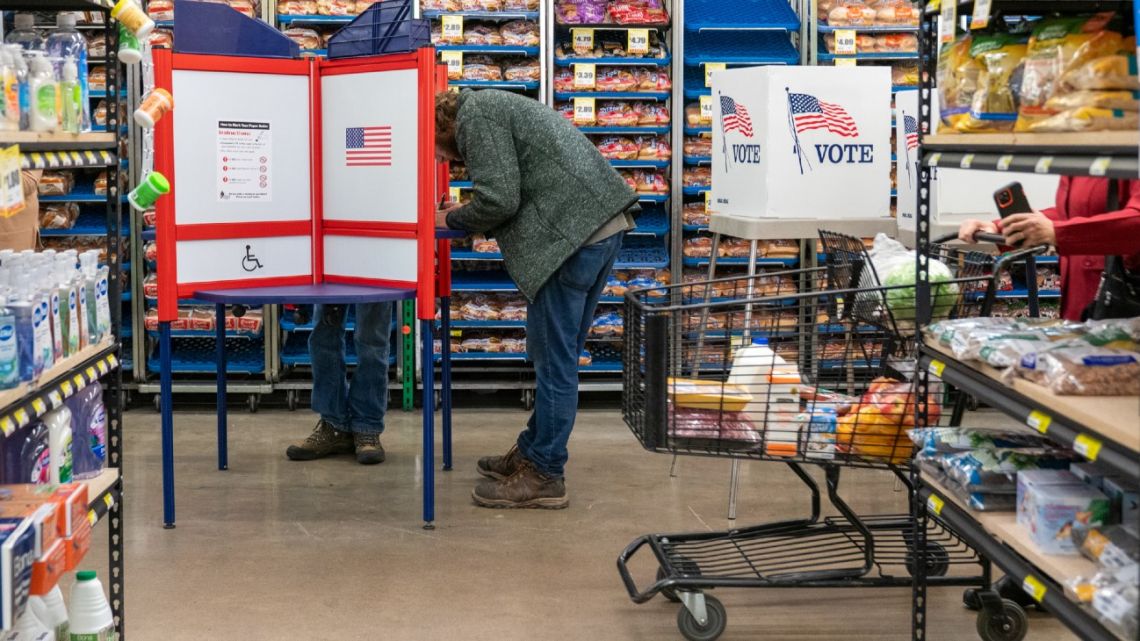
Democrats won control of both chambers of the US Congress in a midterm election landslide that amounted to a rejection of US President Donald Trump following widespread voter discontent with the economy and the war in Iran.
Across the country, Democrats scored victories in GOP strongholds, flipping at least seven Senate seats and winning House races in districts Republicans easily carried in 2024. Several news organisations projected that Democrats would win the House, while Decision Desk HQ projected they took the Senate.
The Democratic rout sets up the first real check on Trump’s power in Washington since he returned to the White House last year, as the party rode a wave of voter dissatisfaction driven by the cost-of-living. The incoming Congress is sure to investigate Trump, his administration and businesses and stymie his legislative agenda.
Throughout the campaign, Republicans struggled to create distance between themselves and the president, whose approval ratings plunged to all-time lows in the weeks leading up to the election as he urged supporters to vote as if he were on the ballot.

Democratic candidates capitalised on that frustration. Their candidates are projected to flip Senate seats in Maine, Kansas, Texas, South Carolina, North Carolina, Iowa and Ohio. Democrats also held seats in Michigan and Minnesota.
In the battle for the House, Democrats won races in Indiana, Iowa, Virginia, Texas, Nebraska, New Jersey and Pennsylvania, among other states. NBC News estimated that Democrats would end up with 255 House seats compared to 180 seats for Republicans. In a sign of how deep the losses were for Republicans, the head of the House GOP’s campaign arm, Representative Richard Hudson, was projected to lose his seat in North Carolina according to NBC News.
'Congratulations'
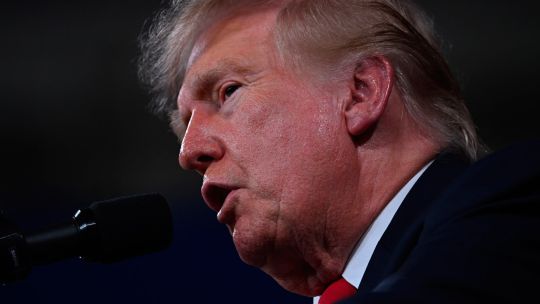
Speaking to Fox News after the election was called, Trump said he thought “part of” the reason Republicans lost were price increases wrought by the war in Iran. He defended his decision to launch the conflict, however, and said he didn’t plan to make changes to his Cabinet.
“Congratulations to the Democrats. They did a good job. They’ve been looking for this one for 11 years, and they finally got it. But I don’t view it as a hit on me,” Trump said.
The president, who watched the election results alongside Cabinet officials and advisers in the East Room of the White House, said he would “accept” the outcome. Trump, without evidence, raised the possibility of widespread voter fraud ahead of the contest.
The uncertainty cast by a divided government in Washington caused investors to pull back from riskier assets, sending S&P 500 Index futures down by as much as 1.4 percent.
Stocks also fell on concern emboldened Democratic legislation will apply greater regulatory scrutiny of high-growth businesses, including the artificial intelligence build-out. Treasuries were boosted by speculation that potential political gridlock will reduce the chance of additional fiscal spending – and the lower bonds yields also weighed on the US dollar.
Democrats overcame a sizeable Republican cash advantage, as well as an unusual mid-decade effort in several Republican-led states to redraw district lines to favour the party’s candidates. Democrats followed suit, but on-net the resulting map favored Republicans.
In the race for the Senate, James Talarico of Texas was projected to defeat Republican Ken Paxton in the state’s hotly contested Senate race, becoming the first Democrat to win a statewide election there in roughly three decades. Trump’s feud with longtime Senator John Cornyn resulted in his GOP primary defeat at the hands of Paxton, whom many considered to be the weaker general-election candidate. The two parties poured nearly US$600 million in ad spending into the race, according to AdImpact.
The Associated Press also projected Adam Hamilton to win in Kansas, marking the first time a Democrat has won a Senate seat there since 1932. Republican Senator Roger Marshall, whose campaign was beset by allegations of aggressive billing practices at his medical office, struggled against rising diesel prices and the fallout from Trump’s tariffs that he supported.
Five-term Senator Susan Collins of Maine was also unseated by Democrat Troy Jackson, who prevailed despite being a last-minute replacement for scandal-plagued nominee Graham Platner.
Former Senator Sherrod Brown beat Republican Senator Jon Husted in the race for an Ohio Senate seat. In Iowa, Democrat Josh Turek was projected to defeat Republican Representative Ashley Hinson for a GOP-held Senate seat.
Democrat Annie Andrews also pulled off a stunning victory in deep red South Carolina, defeating Darline Graham, the sister of the late Senator Lindsey Graham. Darline Graham had filled the seat on a temporary basis, but Trump urged her to seek a full term.
Democrat Roy Cooper, the former governor of North Carolina, prevailed over Republican Michael Whatley. Senator Jon Ossoff of Georgia and Chris Pappas of New Hampshire were also projected to win their races.
In Georgia, Keisha Lance Bottoms was projected to become the first Black woman elected governor in US history and the first Democrat to win the state’s governor’s mansion since 1998. Three-term Texas Governor Greg Abbott was also defeated by Democratic challenger Gina Hinojosa.
Still, The White House also cast blame on GOP candidates, with one official saying on condition of anonymity that Trump did a better job promoting office-seekers than they did themselves. The president himself took to social media to deride Abbott, a longtime ally, as a “RINO,” short for “Republican in Name Only.”
“I wasn’t on the Ballot and if I was, we would have won IN A LANDSLIDE! Thank you for your attention to this matter,” Trump posted on social media.
Trump, however, handpicked many officials running in competitive races including in South Carolina and Texas. His appointments and political feuds with fellow Republicans also resulted in several open Senate seats.
He also told Fox that he would block legislation that Democrats would seek to pass.
“They’ll send over things that are insane, and I’ll veto them. And after a couple of months of vetoes, they’ll call and they’ll say, ‘How do we get this stuff done?’ And we’ll work together,” the president said.
The change in House control, which will take effect Jan. 3, will end Trump’s ability to pass bills solely with Republican support. But that shift is unlikely to result in much successful legislation. Trump will also still be able to flex his executive power on policies including trade, foreign affairs and immigration.
Still, the election will hand Democrats powerful investigative tools. That includes the authority to issue subpoenas — and to undertake impeachment proceedings.
The business world is already bracing for an onslaught of investigations, as Democrats are expected to single out private sector players seen as cozying up to the Trump administration for any signs of special treatment, from contract wins to merger and acquisition approvals.
Deals struck with the president’s business interests and family as well as donations to his pet projects, including construction of a new White House ballroom, are among expected targets.
related news



by Caitlin Reilly, Steven T. Dennis & Hadriana Lowenkron, Bloomberg











Comments