

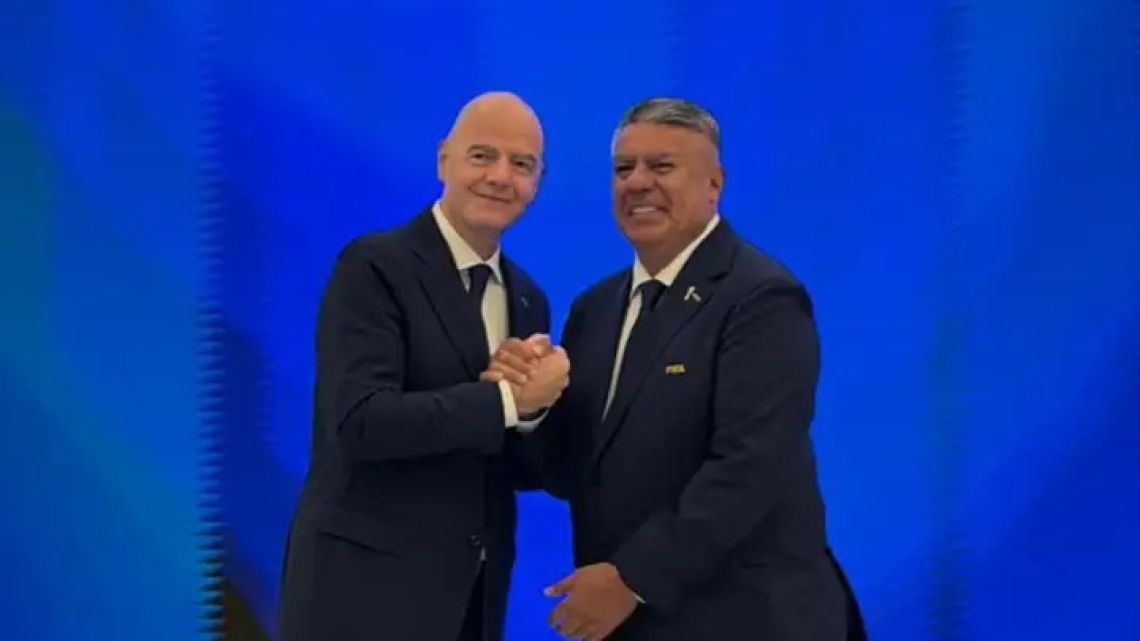
With an off-pitch political storm raging back home in Argentina, Claudio ‘Chiqui’ Tapia spent the week in Doha projecting composure on football’s global stage.
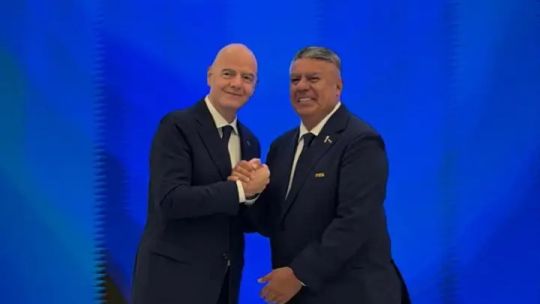
With accusations and investigations dominating the headlines back home, the head of Argentine Football Association (AFA) flew halfway across the world to appear alongside FIFA President Gianni Infantino and CONMEBOL regional football chief Alejandro Domínguez, highlighting his continued backing from the sport’s most powerful officials.
Tapia was in the Qatari capital for FIFA business, formally taking up his role as chair of the organisation’s Laws of the Game Committee, one of its most influential bodies.
The appointment, confirmed last October, places him at the centre of decisions on football’s rulebook and underlines his close ties to FIFA’s top leadership, a relationship he publicly highlighted with images and messages of support from Infantino and Domínguez.

The contrast was stark: a show of institutional strength and international legitimacy in Doha, while a bitter dispute between AFA and President Javier Milei’s government continued to escalate at home.
During a war of words online with freshly sworn-in ruling party Senator Patricia Bullrich, AFA this week accused the Milei administration of making it “a target of its political ambitions.”
The comment came after Bullrich denounced senior AFA figures before the ethics committee of CONMEBOL, the sport’s regional governing body, for alleged corruption while in office.

Bullrich’s complaint on Monday was filed against Tapia and AFA Treasurer Pablo Toviggino. She accused them of violating anti-corruption and anti-bribery rules.
“They have to conduct a thorough investigation of this mafia leading AFA and besmirching Argentine football,” wrote the senator on social media.
The complaint, parts of which were shared by the former national security minister on social media, alleges breaches of the “principles of integrity, fiduciary duty, conflicts of interest, transparency in procurement, proper use of resources and the prevention of money-laundering.”

Bullrich accuses Tapia and Toviggino of running AFA in a "mafioso" fashion.
"The list of irregularities and shady financial management is endless,” she said this week.
AFA pushes back

In response to Bullrich’s claims, AFA issued a statement defending the current management team of Tapia and Toviggino.
It claimed they had taken over “a devastated institution” in 2017 and that their administration had “restored the position that the organisation held in world football.
“Everything that has been done was managed over the course of, and despite, three different governments. Each, in its own way, chose the AFA as a target of its political ambitions,” the statement said, adding Milei’s government to its list.

AFA said it had endured “constant threats of intervention” during former president Mauricio Macri's 2015-2019 government and Alberto Fernandez’s 2019-2023 government.
It added that President Milei’s government has also carried out”‘a coordinated attack” to obstruct the organisation’s functioning and put it under pressure.
AFA, which employs 1,300 workers, noted that it does not receive “a single peso” from the state and noted improvements in the organisation during Tapia’s tenure.

When he took over the post, it highlighted, AFA was in “financial disarray” with massive debt and facing a “deep institutional crisis” after the death of veteran football chief and ex-FIFA official Julio Grondona.
The Milei administration wants to privatise clubs and “impose” its SAD model, “against the freedom clubs have, through their leaders, to choose the model of non-profit civil associations,” the statement continued.
In the text presented before the courts, Bullrich says that there are “evident potential conflicts of interest that remain unresolved" and align "temporally and materially" with ongoing judicial investigations "for alleged money-laundering, tax evasion and asset concealment."
Raids
Bullrich’s complaint comes a week after police made court-ordered raids on AFA headquarters in Ezeiza and several clubs as part of a money-laundering probe.
Separately, in connection with another probe into similar allegations, a home in northern Buenos Aires was searched for information related to individuals that investigators believe serves as so-called “frontmen” for Tapia and a company named Real Central SRL.
According to the probe, the company was allegedly used as a vehicle for holding assets that were not related to the declared economic capacity of its owners.
Among the assets under analysis is a property of more than 10 hectares in Villa Rosa, in the Buenos Aires Province district of Pilar, which has a ranch, heliport, sports facilities, horse training track, stud farm and a collection of luxury vehicles and classic cars.
The ARCA tax and customs bureau has also filed a complaint against AFA last week over alleged misappropriation of tax and social security resources.
On Wednesday, the case took another twist when the Justice Ministry said it would ask AFA and the authorities overseeing Liga Profesional de Fútbol (ex-Superliga), Argentina's top flight, for "explanations about their balance sheets."
Transactions under investigation exceed US$111 million in the case of AFA and US$340 million involving the Liga Profesional de Fútbol.
Tapia has denied any wrongdoing during his tenure.
Since then, the national team has won major tournaments and made major investments into the game, including progress on women’s football.
AFA noted in its statement that both Tapia and Toviggino have been accused of wrongdoing previously and subsequently charged.
Stressing its non-partisan nature, it concluded: “Our teams do not represent a political party, they represent a country.”
– TIMES/AFP/NA







Comments