

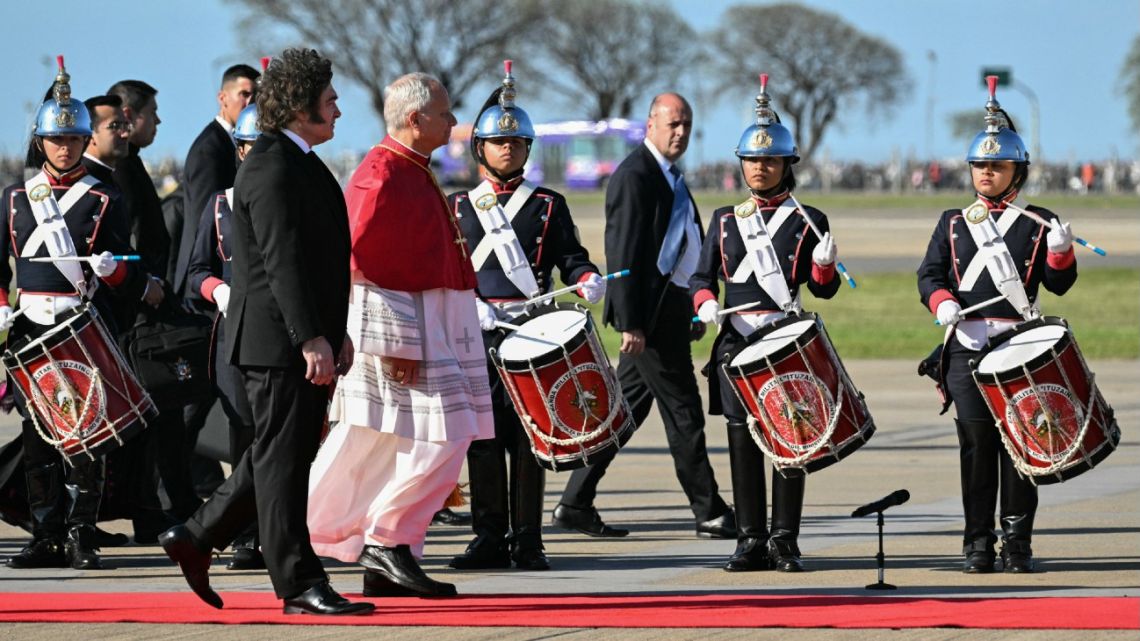
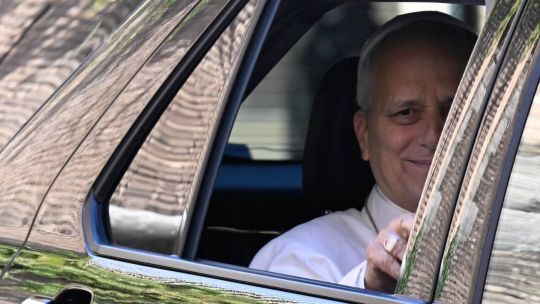
Pope Leo XIV delivered his first speech in Argentina without shying away from the country's central problems: unemployment, falling purchasing power and social indicators highlighting the depth of the crisis.
The Pope brought to bear all the weight of his position as head of the Vatican City State, but above all the authority of being the spiritual leader of the Catholic Church in a country with strong Catholic beliefs.
Without having heard President Javier Milei's speech beforehand, he challenged the libertarian agenda – based on the efforts of the present generation, fiscal austerity and cooling consumption to bring inflation under control – and called for natural resources to be used for the benefit of local communities.
The setting was the Palacio Libertad, where the two leaders engaged in a direct doctrinal and economic exchange. Just minutes before the pontiff spoke, Milei had sought to defend his government programme from a theological and historical perspective, invoking the School of Salamanca, the Ten Commandments – “'Thou shalt not kill', which protects life; and 'thou shalt not steal', which protects property” – and his own interpretation of Christian social doctrine.

“Those of us entrusted with responsibilities of state must govern for everyone and act in accordance with the common good,” the President conceded, before immediately applying that principle to the sphere of macroeconomic adjustment
“For this reason, we apply an economic understanding of the common good, which we call 'intertemporal general equilibrium.' When making decisions, this means not focusing on what a single sector needs at a particular moment, but on the benefit of society as a whole, both now and in the future,” he argued.
According to the Casa Rosada, present-day sacrifice serves as a bridge to the future, based on the idea of securing freedom “without imposing arbitrary measures on some to the detriment of others, and without punishing tomorrow's Argentines in order to favour those of today."

But when Leo XIV took the microphone in the homeland of Jorge Bergoglio – whom both leaders remembered at length – he shifted the focus away from the long term and brought the discussion back to the immediate pressures on household budgets and family tables.
Making ends meet

Instead of the targets of fiscal balance, the pontiff focused on the day-to-day reality of households.
“The common good served by those in authority must also be felt in the concrete conditions of everyday life,” Leo XIV warned, addressing the entire national Cabinet and representatives from across the political spectrum.
The Pope went on to describe Argentina's social deterioration, where having a job is no longer enough in many cases to lift people above the poverty line.

“One of the most basic conditions is being able to live off one's own work. This land knows well the value of the efforts of those who earn their living in the countryside and in the cities, in workshops, schools and hospitals; of those who run businesses and those who sustain their households every day.
"Work enables a person to provide for their family, develop their abilities and feel part of the building of the nation,” the head of the Catholic Church said, before delivering one of the strongest statements of the meeting.
The Pope directly listed the groups hardest hit by recession and falling incomes: “I am thinking in particular of families bearing the weight of uncertainty, those looking for work, and the elderly who have contributed to building society over many years. And those who, despite working, struggle to meet their household's needs.”

He continued a statement that directly challenged the notion of a self-regulating market: “The economy must serve the person, not the person serve the economy.”
Private enterprise with inclusion

The papal message did not dismiss the role of the private sector or wealth creation, but called for that process to be inclusive. Addressing political leaders and business representatives, Leo XIV said that “it is important to encourage everything that opens up opportunities, stimulates private initiative and allows growth to reach even those who face the greatest difficulties."
While Milei had chosen the biblical parable of the two foundations to defend his plan, comparing his course with “a house built on rock” rather than the mistake of building quickly “on sand,” the pontiff recalled that authority “reaches its highest purpose when exercised as a service” and that those who govern “also have a duty to act prudently, recognise the limits of the power entrusted to them and direct their decisions towards the good of the entire community."
Another point of difference concerned funding and the role of the education and scientific research systems – two key areas affected by the Milei government budget cuts.

Leo XIV linked the country's future to support for classrooms and public and private research centres, while also warning about the departure of young people abroad.
“Argentina has abundant human resources. Making this wealth bear fruit for the benefit of everyone requires particular attention to be paid to young people. The opportunities they find today will largely determine whether they can develop their life plans here.
"A nation must seriously ask itself where it has gone wrong when its young people have to leave their homeland to fulfil their dreams,” the Pope said.
Education and research
To stem this loss of talent, the Vatican's position ran counter to cuts in public spending.
“Creating the conditions for them to be able to freely plan their lives in Argentina requires particular efforts to strengthen education, vocational training, universities and research," said the Pope.
Leo also highlighted the country's tradition of social mobility, noting that “throughout its history, this nation has sought to extend education to increasingly broad sections of society."
“Thanks to that effort, generations of Argentines have been able to develop their abilities and contribute to the country's development through the most diverse trades and professions,” he said.
The Catholic leader also called for ethical safeguards in the face of technological advances. While noting that production, medicine, education and science were already using tools such as Artificial Intelligence, he stressed that “technological development requires an ethical awareness equal to the task."
Resources and community
The Milei government is relying heavily on investment in mining, oil, gas and agribusiness to generate foreign currency, but Leo XIV returned to Francis' environmental agenda to raise questions about how the wealth from resulting wealth is distributed.
“Argentina has been blessed by God with extraordinary natural wealth. Its farmland, water reserves, energy sources, minerals and diverse ecosystems offer extensive opportunities for development,” the pontiff acknowledged.
However, he set out a condition to ensure that extractive projects did not become detached from the provinces in which they operate.
“A genuinely human ecology knows how to unite care for creation with care for people, ensuring that the use of these resources contributes to the well-being of communities and preserves the conditions that make life and work possible in their territories," he said.
In his closing remarks, Leo XIV made a political statement that distanced him from a purely financial or individualistic approach.
“There are goods that a society needs and that no public policy can produce on its own. Trust, forgiveness, a willingness to serve and the awareness that one's life has a meaning beyond success or utility are cultivated in personal conscience and in the life of families and communities," he argued.
On his first day in the country, Pope Leo made it clear that the Catholic Church's social doctrine continues to stand in marked contrast to the current libertarian programme.



Comments