


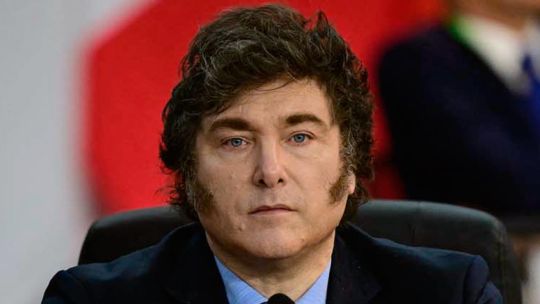
“In the jungle, the mighty jungle the lion roars tomorrow” – at 9pm tomorrow night (which could alternatively be seen as television prime time or an hour when nobody needing an early Monday start will be awake to listen), President Javier Milei will be delivering his third state-of-the-nation address to open this year’s ordinary sessions of Congress in an entirely different context to the previous two.
If previous speeches were mostly written in the past tense (whether his own achievements or the failings of others) when the prime purpose of this occasion is to offer a road map for the parliamentary year ahead, it was a dereliction of duty but understandable when he had only one deputy in every seven and one senator in every 10 to deliver the goods. Now that midterm triumph has given him Congress clout and now that he has already shown a capacity to use it by legislating in such previously taboo areas as labour reform and the criminal responsibility of kids, there can be no excuses if purple prose replaces substance tomorrow.
But as per Isaac Newton’s Third Law of Motion, action and reaction are equal and opposite. The momentum from boosted parliamentary strength is already running into an opposition given a new focus by Milei’s necessary but risky initiative to open up the Argentine economy to the world – a world which might well greet the libertarian lion with “Welcome to the jungle” (not least because of the tariff antics of his idol Donald Trump). Last winter Peronism could achieve a brief unity by running up the flagpole the dubious cause of freeing a Cristina Fernández de Kirchner conclusively convicted on overwhelming evidence of corruption in multiple cases but not enough people saluted in the following midterms. That triumph was the last Milei can win by rallying the electorate against a now crumbling Kirchnerism with the passage of time also making it harder to blame an increasingly distant inheritance – against a drop of almost 25 percent in manufacturing output since Milei took office and the potential collapse of a hitherto protected industry in the face of competing imports now translated into reality with the closure of FATE tyre manufacturers, the opposition has a far more concrete launching-pad.
And yet at the same time the opposition continues to display a fragmentation which gives Milei more opportunities but also places more of an onus. Even the tiny five-seat Convicción Federal upper house caucus of dissident Peronists triumphantly placing Jujuy Senator Carolina Moisés in the first vice-presidency of the chamber last week managed to split again with three of its senators quitting the Peronist interbloc and two remaining inside the fold. This is only a small example but the emerging issue of Argentina’s industrial future could be also divisive for the opposition on a much broader front. The Greater Buenos Aires industrial belt lying at the core of Kirchnerism beyond concerns for Cristina Kirchner’s judicial problems and inland provinces now belatedly tapping their oil, gas and mining resources to export to the world alongside the traditional farm produce are at opposite ends of the clash between protectionism and the open economy – “the productive sector” means different things in different places. “Divide and rule” may continue to work for Milei.

Opening up the economy carries the obvious risk of more FATEs in a near future (even if that closure may have been diverting resources into more profitable Vaca Muerta shale rather than a genuine bankruptcy) and a continued industrial slump. Looking across the Andes, Chile’s experience shows that even such a total catastrophe as the 14.3 percent contraction of its economy in 1982 with unemployment soaring to 23 percent need not be terminal because it removed all the deadwood from the economy and led to almost four decades of sustained export-led growth (interrupted only in 2019), leaving Chile with a higher per capita income than Argentina in a much cheaper country. Those severe birth pangs of 1982 occurred under a military dictatorship, however, and it remains to be seen how much capacity for punishment the Argentine electorate has, despite the remarkable patience displayed until now.
Meanwhile, Milei has a first day of the rest of his term tomorrow with a long way still to go. Let us hope that he takes a newly favourable Congress seriously and presents a solid agenda for the parliamentary year ahead – Argentina has had an ultra-presidential democracy for far too long and it is about time parliamentary democracy was given a chance.






Comments