

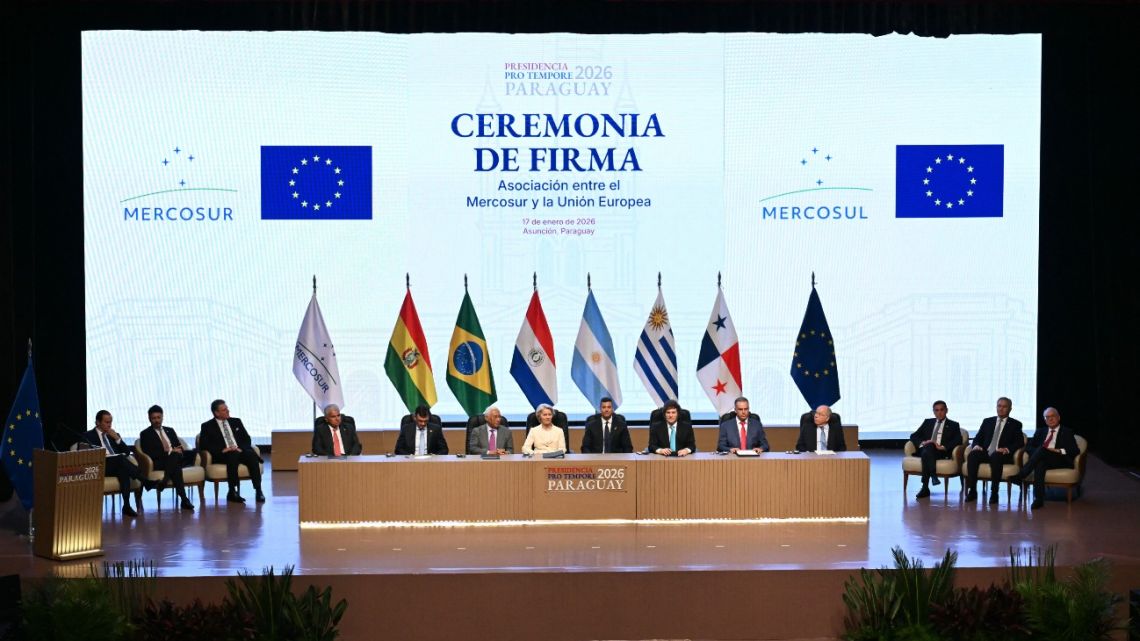
The European Union and Mercosur officially signed one of the world’s largest free-trade agreements on Saturday, clinching a deal that has been in the works for more than two decades.
European Commission President Ursula von der Leyen and European Council head António Costa inked the pact in Asunción, Paraguay, a week after the EU blessed the deal with the South American bloc of Brazil, Argentina, Uruguay and Paraguay.
The agreement, which will create an integrated market of 780 million consumers, will strengthen Europe’s foothold in a resource-rich region that’s being increasingly contested by the US and China. Von der Leyen and leaders like Brazil’s Luiz Inácio Lula da Silva have also touted it as a way to signal independence from the two superpowers.
“This moment is about connecting continents,” von der Leyen said at the signing. “It reflects a clear and deliberate choice: We choose fair trade over tariffs; we choose a productive long-term partnership over isolation; and, above all, we intend to deliver real and tangible benefits to our people and our businesses.”

The signing comes amid the backdrop of renewed US interest in South America. US President Donald Trump’s administration recently issued a national security document that re-prioritised the region for US policy moves. Two weeks ago, the US arrested Venezuelan leader Nicolás Maduro and brought him to New York to face criminal charges.
The gradual erasure of tariffs on farm goods is set to benefit South America’s agricultural powerhouses, while the removal of levies on cars, machinery and other products is positive for European industry. Bloomberg Economics has estimated the deal would boost the Mercosur bloc economy by as much as 0.7 percent by 2040, and Europe’s by 0.1 percent after 15 years.
“We are talking about the largest agreement between two blocs – it puts together economies that account for US$22 trillion,” Tatiana Prazeres, Brazil’s foreign trade secretary, said in public remarks earlier this week. “That will help the region to be better integrated to the global economy.”

Argentina President Javier Milei, Uruguay’s Yamandú Orsi and Paraguay’s Santiago Peña attended the signing ceremony. Lula, who’s been a part of the trade talks since his first presidency began in 2003, didn’t travel to Paraguay but met with von der Leyen in Rio de Janeiro on Friday.
The agreement nearly fell apart in December due to opposition from large farming nations like France and Italy. But safeguard measures offered to European farmers helped sway Italian Prime Minister Giorgia Meloni, leaving France’s Emmanuel Macron without sufficient backing to block a deal, which, after Saturday’s signing, still requires approval by the European Parliament.
The EU’s share of Mercosur trade has fallen to 14 percent from 23 percent in 2001, according to Bloomberg Economics. But the accord will expand its trade network in Latin America to 97 percent of the region’s economy, far greater than 44 percent for the US and 14 percent for China, according to Banco Santander SA.

The pact could help Europe escape its souring dynamics with the United States and China after it spent much of 2025 locked in trade battles with both. It may also prove to South America that Europe can offer a credible economic alternative to the two superpowers – especially as it seeks to lure investments into industry and to develop metal and mineral reserves that are key to Europe’s green and digital transition plans.
Europe and Brazil are in talks for a separate critical-metals agreement, von der Leyen said in Rio on Friday. That deal would “frame our cooperation on joint-investment projects in lithium, nickel and rare earths,” she said, promoting strategic independence “in a world where minerals tend to become an instrument of coercion.”
by Daniel Carvalho & Beatriz Reis, Bloomberg






Comments