

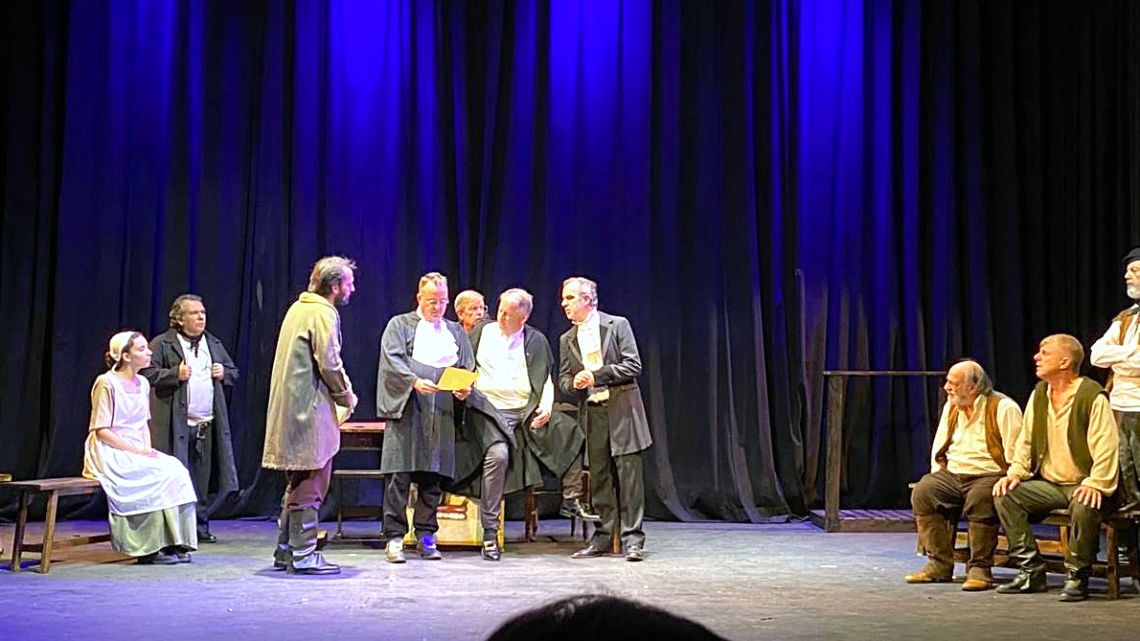
For the second time running a Suburban Players production directed by Simon Chater – Edmond Rostand’s Cyrano de Bergerac last April set around the siege of Arras in 1640 and Arthur Miller’s The Crucible last weekend, famously based on the Salem witch trials of 1692 – has its roots in the 17th century and for the second time running it leaps right into the present day.
Arthur Miller’s play is widely considered an allegory for the anti-Communist witch-hunts of Senator Joseph McCarthy, which were still going strong when The Crucible was penned in 1953 (only starting to lose steam the following year), but this never becomes explicit – instead it is a pretty faithful account of the Salem witch trials (except that the accused were often older and their accusers even younger than shown in the play). Back then Miller could get away with making female hysteria the basis of the charges against the victims of these kangaroo trials, as seems to have been the case – this would be rather trickier today with contemporary feminism.
These trials were, of course, a travesty of justice similar to the McCarthyism which Miller hoped to expose with its underlying perversity that those presumed guilty could only escape the noose by denouncing the even more innocent. Since witchcraft was defined as “invisible,” the need to produce any concrete evidence was dismissed as being neither here nor there with total disregard for truth.
That these tragic 19 executions were the result of mass hysteria is clear enough – where Miller makes the issue more complex are his mixed messages as to whether ideological fanaticism (Puritan fundamentalism then, McCarthyism in his time) or legalistic rigidity and an inability to admit error were more to blame, to which the simple greed of local farmers can be added. The Reverend John Hale, a self-proclaimed expert in demonology, is perhaps the most paradoxical expression of this complexity – he does the most harm when being truest to his mission by denouncing witchcraft left, right and centre until, disillusioned by the abuses of a flawed trial, he switches to trying to save lives instead of souls via false confessions, clashing with the underlying integrity and moral courage of John Proctor, the play’s protagonist, in the final climax.

Miller’s play obliges Chater to direct a cast of 21, above average for the Suburban Players, but there were no visible weak links in the chain.
After evoking an atmosphere of witchcraft with sounds and darkness in the style of Macbeth, the curtain opens on the Parris household whose head, the Reverend Samuel Parris, a self-important clergyman mindful of his income and later derided as a “brainless man” (all well conveyed by Alejandro Solernó), is confounded by his catatonic and supposedly betwitched daughter Betty (Grace Gavin), who later bursts sporadically into wild accusations. But the real villain and architect of the doom of others is the conniving Abigail Williams, splendidly played by Belén Spizzirri, the minister’s niece who weaves her constantly shifting web of alleged witchcraft against any number of respectable pillars of the community.
Abigail is also the maid and former lover of the player’s protagonist, John Proctor, whose past sins and wavering attitudes during the trial cannot prevent his strong-minded integrity from finally shining through – as does even more his staunchly loyal and forgiving wife Elizabeth, a couple giving life to Miller’s faith that at the end of the day “truth will out.” Guillermo Buteler does not fall far behind Daniel Day-Lewis in the 1996 film while Clara Romano adds the right air of melancholy to Elizabeth. The Proctor house is completed by their maid, Mary Warren, a weak and fearful character initially loyal to her employers but unable to stand up to the hysteria of the other girls and an implacable court – all brought across by Malena Chater.

Behind the screams of Abigail and the other girls is the greed of wealthy farmer Thomas Putnam (Alfonso Balaguer), out to gain more land after confiscation from the convicted. His bitter wife Ann (Veronica Taylor) comes closer than anybody to making a concrete accusation by blaming the loss of seven of her children at birth on the witchcraft of local midwife Goody Osborne. Their maid, Mercy Lewis, (Joaquina Zito) is Abigail’s closest ally – ahead of Tituba (Agustina Suárez López), the Indian slave in the Farris household, perhaps the only one of the allegedly bewitched girls with a genuine interest in the occult, and Susanna Walcott (Alexia Chater).
The commanding presence of Lucas Sarquiz does full justice to the complex role and shifting focus of Reverend John Hale, as described above.
One of the best actors in an outstanding cast was David Lear as the outspoken Giles Corey, Proctor’s friend whose age and simplicity place him on the other side of the devious. Francis Nurse (Nestor Cola-Almeida), an honest and respected Salem farmer takes a discreet second place to wife Rebecca (Carola Alfonzo), even more saintly than the Proctors with their final reconciliation with the truth but she is still doomed to the gallows.

The remainder of the cast represent the forces of law and order, apart from the jailed beggar Sarah Good (Adrianne Brandon). The two judges – Thomas Danforth, the Lieutenant-Governor of Massachusetts on a permanent power trip heedless of the destruction caused and arguably the real villain of the play ahead of Abigail or religious bigotry, and John Hathorne – compete with each other to be the most implacable, played with authority by Robert Chatfield and Tim Read respectively. Ezequiel Cheever, clerk to the court, is played as a total bureaucrat by Juan Martín Lamí Dozo (a surname evoking the Veterans Day anniversary in the previous week).
Last but not least (apart from his assistant played by Martín Millan) is John Willard, the local marshal and prison guard played by Joe Elverdin – perhaps the most visibly drunk character since Enrique Pinti in Esperando la Carroza, no foreign accent this time but yet to use normal diction full time.
Space does not allow stage management, lights, sound, costumes, etc. from being given their due but they were all good. A lengthy play (Arthur Miller’s fault rather than Chater’s) but it sustained its pace throughout and was given a hearty applause by a full house at the British Arts Centre, including British Ambassador David Cairns and his wife Sharon.

The remaining seven performances will all be at The Playhouse, Moreno 80, San Isidro – April 18, 24, 25, 26 and 30 and the first two days of May. More information from [email protected].














Comments