

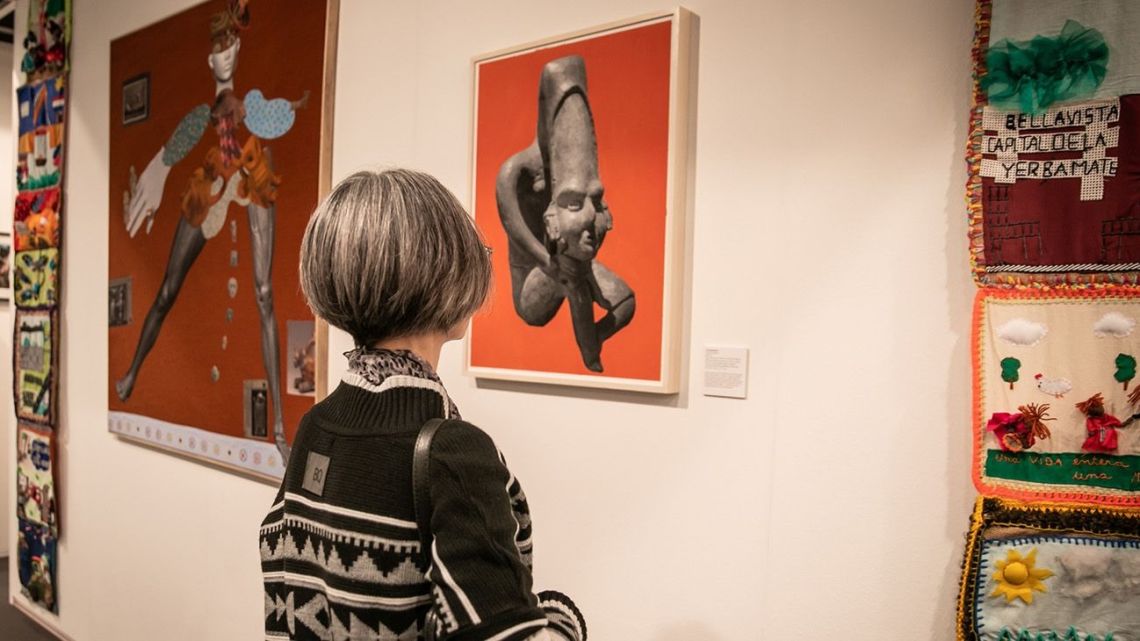
Fundación arteba will celebrate its 35th anniversary with a new edition of its eponymous fair, one of Argentina's leading contemporary art events. The showcase will take place from November 6 to 8 at La Rural's Pabellón Amarillo, with exclusive pre-opening days for industry leaders and buyers in the preceding two days.
The edition will bring together works from 70 galleries and projects spanning across Argentina, Uruguay, Chile, Brazil, Peru, the United States, the United Kingdom, Portugal, Puerto Rico and France. The selection is intended to reflect the diversity of the local contemporary art scene and its dialogue with the international circuit.
In addition to works and proposals from participating galleries, arteba 2026 will feature several curatorial sections, a programme of conversations and a space specifically dedicated to international exchange.
Different perspectives
Works in the fair’s ‘Principal’ section were selected by an independent committee comprising Nicolás Barraza, director of Mite gallery in Buenos Aires; Juan Eyheremendy, director of Vermelho gallery in São Paulo; Florencia Giordana Braun, director of Rolf Art gallery, also Buenos Aires; and independent curators Florencia Malbrán and Lara Marmor.
Galleries from different generations feature, representing a range of profiles, including Alejandro Faggioni, Aninat Galería, Barro, Calvaresi, Centro de Edición, CONSTITUCIÓN, COSMOCOSA, COTT, Crudo, de Sousa Galería, Del Infinito, Diego Obligado Galería de Arte, El Mirador, Galería de las Misiones, Galería Maria Casado, Galería Palatina, Galería Sur, Grasa, Herlitzka & Co., Isabel Anchorena, Isla Flotante, Jorge Mara-La Ruche, La Mala, Linse, MC galería, Mite, Moria Galería, Mostra, NN, Nora Fisch, Ohno, PASTO, PIEDRAS, Piero Atchugarry Gallery, Quimera, Remota, Roldan Moderno, Rolf Art, Rubbers, Ruth Benzacar Galería de Arte, Selvanegra Galería, SUBSUELO, The White Lodge, TOMÁS REDRADO ART, Towphya, Valerie’s Factory, Via Margutta, W-galería and Witcomb.
The variety on show ensures proposals associated with different forms of expression, generations and artistic pursuits within Argentine and Latin American contemporary art.
The programme also features ‘Utopia,’ a section curated by artist Juan José Cambre and artist and independent curator Santiago Villanueva.
The section will bring together works from BAC, Departamento 112, Deskomunal Galería, Dicha, Fantasma, galería casa proyecto, Galería Cielo, Galería LADO D, GARRA, hipopoety, La Mesa, Palos, Pionera, Polvora, Satélite and Triple Frontera.
The initiative incorporates projects and galleries that broaden the fair's panorama and offer an insight into different forms of production, circulation and exhibition in contemporary art.
A returning theme for this edition is the ‘Zona de Diálogo Internacional,’ a space combining the participation of foreign galleries with a programme of talks examining the challenges, tensions and opportunities facing Argentina and the wider Latin American contemporary art within the new global landscape.
Participating galleries will include Galeria Vermelho, from São Paulo; Galerie Jocelyn Wolff, from Paris; 3+1 Arte Contemporânea, from Lisbon; Embajada, from San Juan, Puerto Rico; and Cecilia Brunson Projects, from London.
Their presence should strengthen exchanges between the Argentine scene and the international circuit, as well as generate discussions around the conditions currently affecting the art market and artistic production.
A fair as a city
For the fifth consecutive year, Estudio Torcello is responsible for the design of arteba's main event. This year's project will occupy 11,000 square metres of La Rural's exhibition grounds.
Architect Horacio Torcello has proposed altering the usual experience of walking through an art fair – rather than organising the space around a succession of rows and stands, the experience now incorporates rest areas and meeting points that also serve as viewing platforms.
"The heart of the plan is a route conceived as a living organism rather than a grid," Torcello explained. The intention is to allow visitors to stop, observe the overall scene from different perspectives and establish different rhythms as they move through the fair.
The idea is to make the fair something that can be returned to, several times. Paths, plazas and meeting spaces have been designed to offer different perspectives as visitors retrace their steps.
The "arteba [fair] lasts only a few days, but the plan is designed to make people want to stay during those days: not just a fair for looking at art, but a place to meet others while doing so," said the architect.
This latest edition of the popular fair arrives as the Fundación arteba celebrates the 35th anniversary of its founding.
Over four days, from the pre-opening on November 4 and 5 to the general opening from November 6 to 8, La Rural will become a meeting point for artists, gallery owners, collectors, curators, industry professionals and members of the public interested in discovering the trends and debates shaping contemporary art.
With 70 galleries from 11 countries, new curatorial proposals and a spatial design intended to transform the traditional fair experience, arteba 2026 aims will celebrate its history and longevity while expanding and highlighting the ways in which audiences encounter contemporary art.





Comments