

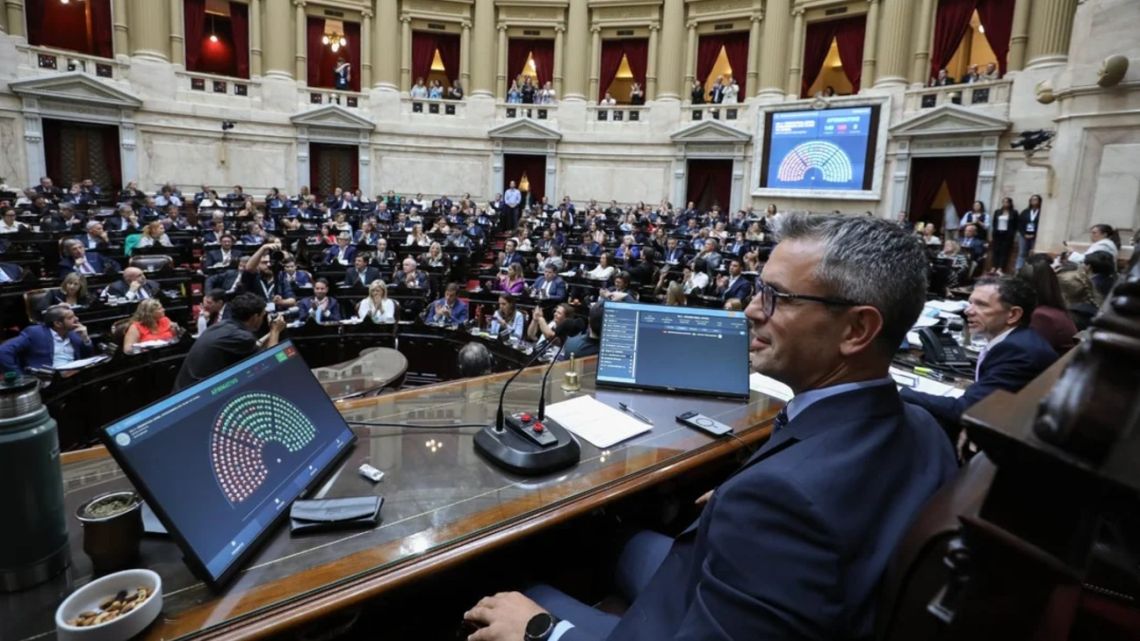
Argentina’s lower house Chamber of Deputies has granted approval to the text of the free-trade agreement between Mercosur and the European Union, sending the deal for ratification in the Senate.
With 203 votes in favour, 42 against and four abstentions, the agreement signed on January 17 in Asunción last month completed its passage through the lower house in the early hours of Friday morning.
The deal, which President Javier Milei’s ruling party caucus passed with the support of allies and dissident Peronists, would eliminate tariffs on more than 90 percent of Mercosur exports to Europe and reduce trade barriers for European industrial goods.
The EU-Mercosur treaty is expected to reach the Senate within two weeks for final approval. If that timetable is met, Argentina will become the first country to ratify the sweeping trade accord.

The deal was inked on January 17 in Asunción, Paraguay – which currently holds Mercosur’s rotating presidency – during a ceremony attended by President Milei and counterparts Santiago Peña (Paraguay) and Yamandú Orsi (Uruguay). Brazil’s President Luiz Inacio Lula da Silva, was absent.
Its implementation would create the largest free-trade area in the world, linking the European Union’s 27 member states with Argentina, Brazil, Paraguay and Uruguay – a combined market of some 700 million people.
But the pact has faced fierce resistance in several European countries, most notably France, particularly over its potential impact on the nation’s agricultural and livestock sectors.

The European Parliament referred the agreement to the courts in January. That decision delays the treaty’s formal implementation by several months, although the European Commission – the EU’s executive arm – could opt to apply it provisionally.
La Libertad Avanza secured backing of lawmakers from PRO, UCR and Provincias Unidas, along with others from dialogue-friendly blocs. In a twist, the ruling party also captured 43 votes from the opposition Unión por la Patria force, including that of Peronist caucus leader Germán Martínez.
Underlining the extent of the Peronist split, that figure surpassed the 38 Peronist votes – from La Cámpora, Kirchnerite sectors and lawmakers aligned with deputy Juan Grabois – cast against the initiative.
Debate
Critics warned of the potential harm for Argentina’s productive and industrial sectors and bemoaned the lack of a national development plan to counter the deal’s impact.
Former foreign minister Santiago Cafiero criticised the details of the trade deal, which was originally agreed in 2019 under Mauricio Macri’s administration. He warned that, historically, Argentina had negotiated higher beef quotas and tariff reductions, claiming that the treaty placed 20 percent of national exports at risk.
In Cafiero’s view, the deal amounted to a surrender of sovereignty in the face of set EU conditions, reflecting a free-market policy that in practice ran up against protectionist “walls” abroad. He also argued that the agreement did not promote industrial growth but instead sought to pigeonhole Argentina solely as a producer of raw materials.
Veteran Peronist Agustín Rossi, a former government minister, spoke in favour of ratification.
“This is an agreement that strengthens Mercosur, consolidates it as a commercial economic actor and enhances its international standing,” Rossi said. “I will vote in favour of the agreement. In my view, it represents strategic insubordination towards President Donald Trump.”
Encuentro Federal national deputy Miguel Ángel Pichetto also defended the agreement, describing it as a state policy that opens access to “more than 500 billion consumers.”
Pichetto said the pact marked the culmination of a policy spanning nearly three decades and transcending successive governments.
He recalled that since 1999 every president of Argentina had insisted on the strategic need to cement ties with the European community. For him, the step represented “the crowning achievement of sustained diplomatic effort over time,” regardless of political colour.
‘Fast-track vote’
Unión por la Patria deputy Julia Strada announced her abstention on the bill ratifying the January 17 agreement, describing it as a “fast-track vote” imposed by the government that “does not guarantee substantive debate.”
“I will abstain from a decision that is clearly a trap. I will also propose urgent hearings with the sectors involved, urgent technical reports – one from the Congressional Budget Office – an implementation plan if this moves forward,” she said.
The Kirchnerite lawmaker called for a debate on President Milei’s industrial policy, which she sharply criticised.
Her colleague Eduardo Valdés also questioned “the urgency” of approving the agreement when the European Parliament has halted its implementation indefinitely.
“What is the rush? Why didn’t Foreign Minister [Pablo] Quirno come to Congress? Because on February 5, President Milei signed a trade agreement with the United States, breaching a fundamental Mercosur principle – the common external tariff. Argentina went it alone. That is why I cannot support this agreement,” argued the former ambassador to the Vatican.
In closing, the chair of the Foreign Affairs Committee, Juliana Santillán of La Libertad Avanza, said “this agreement sends a clear signal” to the rest of the world.
“The government believes in international trade as a tool for development and genuine growth,” she stressed, as well as for “intelligent integration into the world.”
“The objective is clear: to expand and facilitate trade in goods and services, reduce tariff barriers, improve competitiveness and strengthen cooperation,” she said.
“We need markets, clear rules and trust. This agreement contributes to those goals,” Santillán concluded, emphasising that “we are facing a strategic decision that transcends governments.”
– TIMES/AFP/NA













Comments