

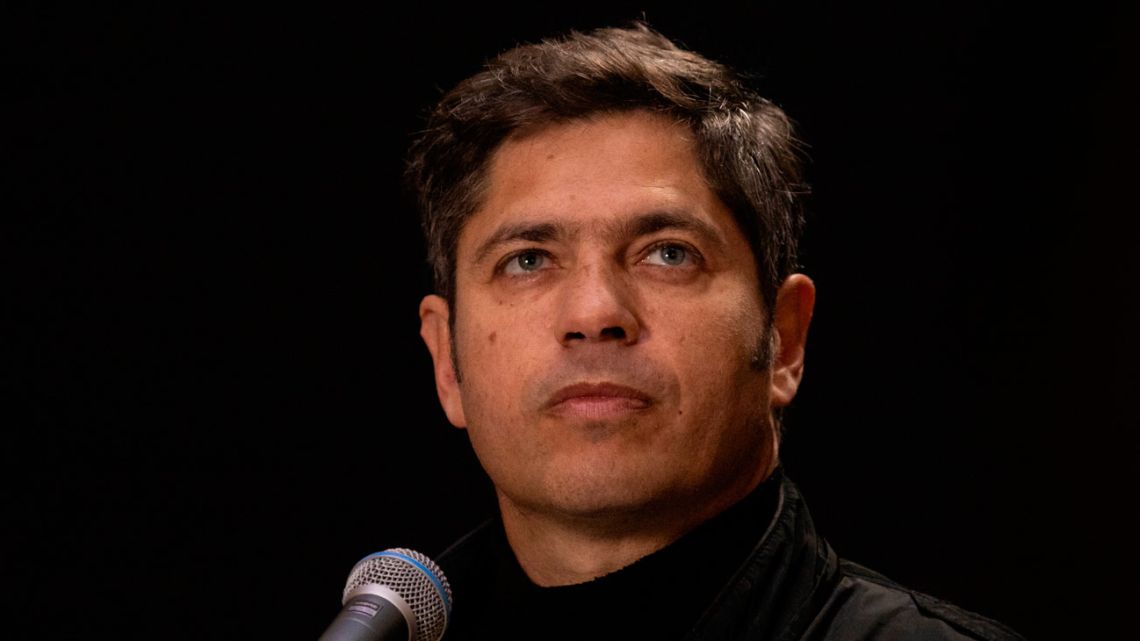
President Javier Milei’s government hit out at the opposition on Friday following a favourable US court ruling in the long-running YPF expropriation case, taking aim at Buenos Aires Province Governor Axel Kicillof and accusing him of “brazenly lying” and putting the country at financial risk.
The ruling, issued by the United States Court of Appeals for the Second Circuit, overturned a massive damages award linked to the 2012 nationalisation of oil company YPF and also confirmed that the company itself was not liable in the expropriation process.
In a strongly worded statement issued by the Presidential Office, Milei’s administration described Kicillof — economy minister at the time of the nationalisation – as a “failed former minister” and argued that his management led to litigation that dragged on for more than a decade in New York courts.
“His irresponsibility and reckless statements plunged the country into a 12-year lawsuit in New York that cost more than US$50 million and exposed the assets of all Argentines to the risk of having to pay US$18 billion,” the statement said.

The government added that what Kicillof was now “brazenly celebrating as a personal victory was in fact a time bomb that this administration’s legal team had to defuse with absolute professionalism.”
“Had there not been serious and responsible legal management, Kicillof’s absolute negligence would have caused an irreversible financial catastrophe for Argentina,” the administration warned.
It argued that his “populist policies” created a climate of severe legal uncertainty that for more than a decade scared off investment and slowed economic development.

“A large part of the decline and hardship Argentines have suffered over the last 10 years is directly due to his irresponsible and senseless actions: companies were not created, investment in Vaca Muerta advanced slowly and thousands of productive sectors were paralysed. The costs we paid for his negligence were monumental and we are still bearing them today,” the statement said.
Milei’s government further accused Kicillof of “having the insolence to present himself as a hero and celebrate a decision that does not erase even a millimetre of the disaster he himself caused.”
“The priority of President Javier Milei is to defend the assets of Argentines, not to endanger them with ideological improvisation or use them as a tool for cheap propaganda,” the statement concluded.

Kicillof is one of the opposition Peronist movement’s main leaders and is widely seen as a possible presidential candidate in 2027.
Kicillof: ‘Sovereign decision’
Kicillof, who served as economy minister during the 2012 nationalisation and is now governor of Argentina’s most populous province, also celebrated the ruling.

He hit back at Milei, warning that “this was not about attacking me, but about questioning a sovereign decision and defending foreign interests.”
Writing on social media after the US court decision in Argentina’s favour, he welcomed the move to overturn the ruling against the country.
“For years, lies were told. In the end, it was a narrative pushed by the vultures to question a sovereign decision and make themselves even richer,” he said.

In Kirchnerite political discourse, “vultures” refers to so-called vulture funds — hedge funds and holdout creditors that buy defaulted debt at low prices and later sue for full repayment.
He added that while Milei spoke about a so-called “Kicillof tax,” Argentina’s own state lawyers had, since the beginning of the case, defended in court the same arguments his team had always maintained.
“That ‘tax’ was nothing more than an operation – a chorus of voices that for years repeated the arguments of the vultures, claiming the nationalisation had been technically incorrect. Was it ignorance, naivety or a deliberate lie? Today it is clear,” he wrote.

“The right would never have nationalised YPF. They always worked for the vultures, yet paradoxically today their model does not collapse due to a lack of dollars thanks to YPF. Milei dresses up in YPF overalls, but he never defended the company – he acted as an employee of foreign interests,” he added.
Kicillof argued that nationalising YPF was “one of Argentina’s most important strategic decisions of recent decades,” saying the company is now a key development engine and crucial in mitigating the impact of the global energy crisis.
Fernández de Kirchner speaks
Former president Cristina Fernández de Kirchner also defended YPF’s nationalisation in a post on X, stating that “the provisions of a company’s bylaws cannot prevail over a country’s Constitution and legal system.”
In a lengthy message, she thanked the law firm Sullivan & Cromwell LLP for representing the Argentine state in New York courts and said the legal arguments reaffirmed the primacy of the National Constitution over corporate statutes.
The former president argued that the 2012 expropriation was carried out legally and as an exercise of state sovereignty.
Fernández de Kirchner, who is serving a corruption sentence under house arrest, also said the decision to regain control of YPF and Argentina’s energy sovereignty had been strategic.
She noted that the development of Vaca Muerta since 2012 had allowed the country to achieve a multi-billion-dollar energy trade surplus.
However, the litigation – which began in 2015 and saw an adverse lower-court ruling in 2023 by Judge Loretta Preska – could still reach the United States Supreme Court, where the parties may file a final appeal.
– TIMES/NA











Comments