

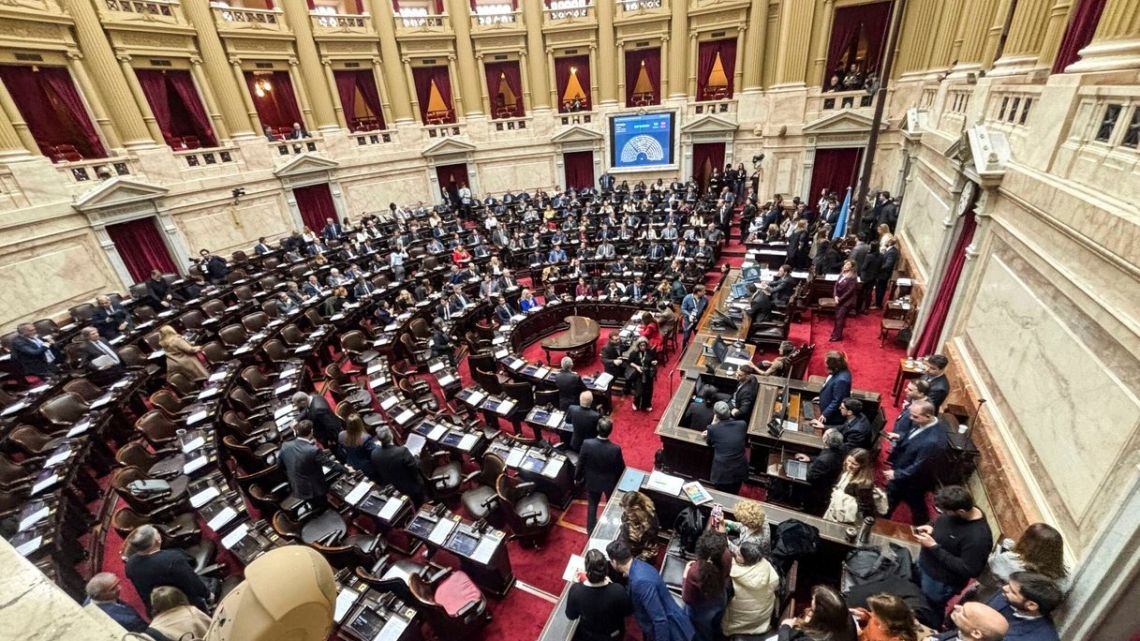
President Javier Milei’s government is pressing for a major electoral reform that would reshape the rules ahead of the 2027 elections, suspending the primary elections in a move that could complicate opposition efforts to unite behind candidates and resolve internal disputes.
The government’s bill, put to the Senate Thursday night, combines the suspension of the PASO primaries for 2027 and introduces changes to candidate eligibility and voting procedures. It forms part of Milei’s push to overhaul the electoral system ahead of next year’s presidential and legislative elections.
Milei’s ruling La Libertad Avanza party was confident it had secured sufficient support in the Senate for the revised bill, which was substantially scaled back after negotiations with opposition caucuses willing to back the initiative.
The government had intended to abolish the PASO process altogether, but had to settle for suspending it in order to secure broader support.

Senate leader Patricia Bullrich expressed confidence ahead of the vote, while Cabinet Chief Diego Santilli said the government would secure more than the 37 votes required to pass the bill.
“The government and the public can rest assured and not have to live from one election to the next. Hopefully, in Argentina, voting will take place on a single day across all provinces; the first elections are due to begin as early as February,” said Bullrich as she entered the Senate Thursday.
Santilli described suspending the primaries as “a structural change proposed by the President” and justified it on three grounds: avoiding forcing voters to go to the polls as many as six times in an election year, saving the US$200 million the system costs, and reducing parties’ exposure to campaign advertising.

“People switch off the radio, the television. They don’t want to hear any more,” he argued. “This is a reform for society, not for the political leadership.”
The reform’s three main changes are the suspension of the PASO primaries for 2027, the introduction of the long-proposed ‘Ficha Limpia’ regime barring candidates convicted of certain crimes, and changes to the paper ballot system allowing voters to select an entire party ticket with a single mark.
The legislation, originally comprising 79 articles, was reduced to 25 following negotiations between the ruling party and opposition caucuses willing to support it. It leaves the primary election system introduced in 2009 in place, but suspends it for next year’s presidential and national legislative elections.

Parties will therefore have to choose their candidates through internal elections or consensus mechanisms established in their own party statutes, while electoral alliances will follow their respective rules. Each political grouping will be allowed to field just one list per category, with legislative lists required to comply with gender parity rules. The deadline for registering candidates will be August 30, 2027.
The bill also introduces the 'Ficha Limpia' (“clean slate”) regime barring candidates convicted of intentional crimes whose sentences have been upheld on appeal, even if further judicial appeals remain pending. The disqualification will apply where the ruling has been communicated before December 31 of the year preceding the election, and remain in force until the sentence is served or the conviction overturned. The National Electoral Chamber will maintain a public registry of those affected.
The restrictions will also apply to appointments to senior government positions, including the Cabinet Chief, ministers, secretaries and undersecretaries, as well as officials in state agencies and companies with government participation.

Other provisions reduce the free airtime broadcasters must allocate to political parties from 5 percent to 2.5 percent of total programming time, change campaign advertising deadlines, lift certain restrictions on commercial, cultural and social activities on election days, and eliminate mandatory presidential debates before the first round. A debate will remain compulsory in the event of a run-off, to be organised by the National Electoral Chamber within the 10 days preceding the vote.
Argentina’s 43 representatives to the Mercosur Parliament (Parlasur) will continue to be appointed rather than directly elected, with 24 selected by provincial legislatures and Buenos Aires City and 19 by Congress.
If approved by the Senate, the bill must pass the Chamber of Deputies without amendments to become law.
– TIMES/NA/PERFIL
related news
UBA authorities block controversial tribute to ERP guerrilla leader Mario Roberto Santucho
Key Milei ally Bullrich says re-election at risk unless Argentina's economy improves
Milei’s Senate chief Bullrich confident electoral reform will pass








Comments