

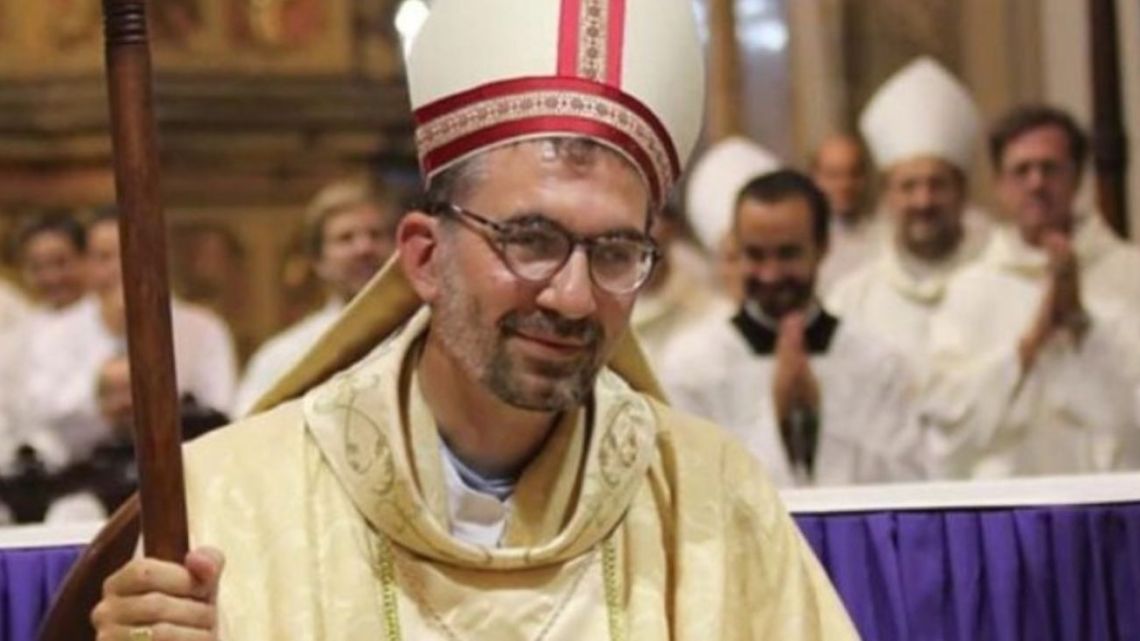
Gustavo Oscar Carrara, the metropolitan archbishop of La Plata, is concerned over the defunding of key urbanisation works in the more than 6,000 informal villas (shanty towns or low-income neighbourhoods) in the country, where approximately five million people live.
In an interview with Modo Fontevecchia (broadcast on Net TV and Radio Perfil AM 1190), the Catholic leader said the budget for infrastructure projects has been slashed and warned the Secretariat for Socio-Urban Integration (SISU, Secretaría de Integración Socio-Urbana) “is in danger of closing.”
Carrara has been the archbishop of La Plata since late 2024, when he was appointed by the late Pope Francis. He worked as a suffragan bishop in Buenos Aires; he is also the president of Cáritas Argentina and previously served as the organisation’s vice-president.
He is widely recognised as the first “shantytown bishop” in Argentina, due to his extensive pastoral work in slums, particularly Villa 11-14 in Bajo Flores.
I’d like a balance from you on the current social situation and the criticism voiced by the Church.
We [recently] held a press conference at Cáritas together with other social organisations, and another organisation called “Por Mi País” (“For my country”), to discuss the topic of socio-urban integration of shantytowns or working-class neighbourhoods, especially how that public policy had been defunded and how the Secretariat for Socio-Urban Integration – which applies this public policy and has survived different governments after starting from the bottom up – is now in danger of closing.
There was a survey of shantytowns and low-income neighbourhoods in 2016, first conducted by locals. If we asked how many shantytowns or low-income neighbourhoods there were in Argentina 10 years ago – the number wasn’t really known and an exaggerated estimate was believed to be 1,000. But that first census actually showed that there were 4,416 shanty towns or low-income neighbourhoods. It was updated afterwards because there was still work to be done.
It’s a known fact that there are at least 6,400 shanty towns or low-income neighbourhoods where five million people live, out of which more or less two million are children and teenagers. A law was voted on in 2018 to stop evictions because where are the five million people going to be housed following that logic? They were neighbourhoods which had already been integrated.
There was a trust fund ensuring [public] works in those neighbourhoods. Those works have to do with sewers, drinking water, safe electricity but also some schools, health centres, sports and cultural spaces. And the companies who had taken on those works also had the obligation to hire workers who were 25 percent local, to help in their training if necessary and, otherwise, to hire them directly because many of them are construction workers. That generated genuine jobs in the neighbourhoods as well as those very necessary and specific works.
They were defunded from 100 to three percent. They were works which were being completed in a trickle-down mode. They moved very slowly but they did move. Now this Secretariat may be closed and the workers may be dismissed, which was sort of the executive arm of this public policy.
Out of those over 6,000 neighbourhoods, with five million people living there, what percentage is located in Buenos Aires City and Greater Buenos Aires?
In Buenos Aires Province, there are 1,800 shantytowns or low-income neighbourhoods.
And in Buenos Aires City?
In the City there are large shantytowns. As calculated by the ReNaBaP (National Registry of Low-Income Neighbourhoods), there are 52 shantytowns or low-income neighbourhoods. The figure in the Buenos Aires Metropolitan Area may be around 2,000.
If there are 2,000 in the Metropolitan Area out of 6,000, that’s a third. That would mean 1.5 million people. I was recently in Brazil, and they told me there are 1,900 low-income neighbourhoods in Rio de Janeiro – that’s just one city and that around five million people out of a total population of 18 million people live there. If one considers the total number of Argentines in that condition, that’s 15 percent of the population. In Rio de Janeiro, that’s 25 percent. One out of every four cariocas live in what they call a favela community. If we took these data in Argentina 25 years ago, surely it would be half the number of settlements and also half the population.
Exactly.
When one asks authorities in Buenos Aires City, they say they get complaints from neighbours paying rent or common charges, more expensive than the money paid by those whose neighbourhoods are being renovated. How do you yourself equalise the complaints of those lower-middle class Catholics who struggle to rent, with the criticism of those who are helped to find housing without having to pay any cost? What do you say to people who are inches away from falling on the other side?
Firstly, those of us who are leaders or have a responsibility have to work towards a culture of encounter and not the comparison of our statements. Now, many things also have to do with ignorance and the ordinary neighbour doesn’t have to know.
Many times, there is a plan to renovate housing but the dwellings those neighbours had built are torn down, which was also done with effort, with their own work. They’ve gone from sheet metal and wood to a brick structure and have built their own slab thinking of their children or grandchildren. So, they’ve invested effort, money, work and have built those dwellings with their bare hands, in many cases by helping each other.
In all classes there are people who don’t work, who are lazier, so to speak. But that doesn’t mean shantytown dwellers get everything for free. In many cases, a payment plan has been agreed on based on their possibilities for those dwellings. We have to seek dialogue.
One of the elements one finds in the lower-middle class is the criticism of people on benefits making almost the same as employees with low salaries. It was more common to find the word “benefit” being used in a derogatory way by people in the lower-middle class than in the middle and upper-middle class. Raising awareness is the great task of any communicator, the Church being at the head. Such division is what encourages eliminating the decision to help urbanise those neighbourhoods which cannot be moved, so there is no choice but to do so.
Yes, clearly. That also entails a development plan for Argentina. If there’s one thing Argentina is not short of, that’s vast land. There ought to be a plan to repopulate Argentina in unpopulated areas. It’s another analysis but it must be done.
















Comments