


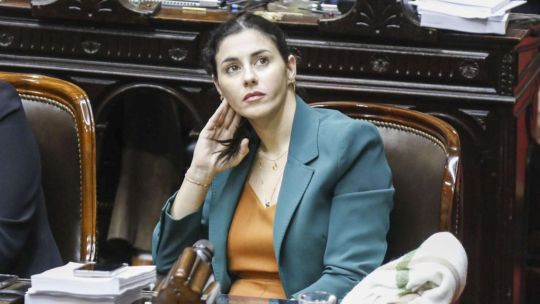
Senator Carolina Moisés, the recently designated provisional vice-president of the upper house, affirms that for major social sectors such as the new generations, “Peronism belongs to the past.”
For the lawmaker, President Javier Milei won last year’s election, “but the truth is that it was we who lost,” she told Modo Fontevecchia (Net TV y Radio Perfil AM 1190) in an interview. The challenge facing the party today is simple, she says: “We either return to being Peronist or Peronism will cease to exist.”
Moisés, 50, attributes the party’s current reality to former president Cristina Fernández de Kirchner and the La Cámpora political youth organisation, describing the latter as “the worst thing which ever happened to Peronism.” The grouping, headed by Máximo Kirchner is “a sect with a one-track mind,” she said.
The Jujuy leader, who chairs the Convicción Federal caucus, last month led her senators out of the Unión por la Patria interbloc along with fellow-senators Guillermo Andrada and Sandra Mendoza.

“My being the Senate’s provisional vice-president today has to do with Peronism in all its variants deciding not to occupy positions of power. Due to that vacuum caused by a not only dogmatic but even capricious stance of denying reality, we lost votes and our majority in the Senate,” she argues.
“At what point did we lose that link with society? Why did we not manage to interpret the new generations?” Moisés recognised party infighting “with Kirchnerism clearly part of the problem.”
“It would be great if we were capable of constructing a Peronism without Kirchnerism,” she considers.
Do you see an opportunity to reconstruct Peronism into more than a threat, so that it can beat Milei in 2027?
I hope we make it to 2027. I believe that a strategy at various levels needs to be outlined.
Why “I hope we make it to 2027”?
I’m trying to be realistic. Today Peronism has dropped to its historic floors everywhere. We used to have 20 or so governors. If we are not capable of understanding our weaknesses, we’re never going to transform them into strength.
If you compare governors, from 23 out of 24 to six today. If you compare senators, from our historic two-thirds majority to 25 (out of 72). If you compare deputies, the caucus is on the verge of rupture because the tensions are enormous. We complain because we lack seats, we complain because we have no quorum. Now why are they lacking? Because last year we had the wrong electoral strategy and because in 2023 we lost power. Milei won but the truth is that it was we who lost.
It is said that Kirchnerism broke the thermometer measuring its relationship with reality, living in a kind of time capsule and believing that everything stays the same when Argentina has changed over the last 20 years. Is that your diagnosis?
Yes. Unfortunately for vast social sectors, like the new generations, Peronism is something good from the past, something which happened to their grandparents when father could go to work while mother could run her household. I’d like to think that Peronism is going to be something good in the future. But to look ahead to that future, we must have a good diagnosis of our present, not deny our differences and expel people.
[Peronist governors] are criticised and questioned and treated as traitors. It is very easy when you're not governing. What a coincidence, that no Kirchnerite is governing a province! Nobody from La Cámpora is governing anything, except two or three Greater Buenos Aires town halls.”
Today’s narrative is about failure or the past – you hear it and say: ‘Well, we did that, what are you going to do in the future?’
When constructing a collective thinking, we must first remove the label – we either return to being Peronist or Peronism will cease to exist. Kirchnerism was a grand construction of leadership beginning with Néstor [Kirchner], who really transformed politics. So what Kirchnerism are we talking about? Of Néstor, who was capable of constructing a transversal umbrella for all those governors left orphans after 2001, who was even capable of containing the Radicals and convincing [Raúl] Alfonsín? We had a Radical vice-president on Néstor’s decision. So what Kirchnerism are we talking about? Of that or sectarian Kirchnerism, of one-track thinking running on obedience?
Separating Néstor Kirchner from Cristina Fernández de Kirchner, let us say that what remains today seems to represent Cristina. In that sense, does it represent [Buenos Aires Province Governor Axel] Kicillof or place him outside?
The new Peronism has to be constructed alongside post-Kirchnerism. This does not mean denying that Kirchnerism existed, that we formed part of it and in many cases take pride in it or that it transformed much of the country. Now I refuse to let Peronism end up being a sect of one-track thinking where nobody can think differently and the option is obedience or treason. That is not Kirchnerite logic, it’s La Cámpora logic. La Cámpora is the worst thing to happen to Peronism, extorting Kicillof.
Has Cristina become a testimonial leader, somewhat like Elisa ‘Lilita’ Carrió in her time?
I believe that she is reaching that point. The problem is that she clashes with the nature of Peronism, which is pragmatism underwritten by a doctrine.
In other words, a party of power, not a party as it should be.
If anything characterised Peronism, it is that ambition for power and the construction of an identity. It is always said: ‘Peronism is something felt, not understood.’ Many people say that anti-Peronism is also constructed from not understanding our logic. Now it is a mass party which has ceased to represent the masses. What is Peronism doing? Pointing fingers at some governors, covering up for others, questioning and blackmailing others like Kicillof because we are not going to say that La Cámpora is not extorting Kicillof.
Could we say that the problem of Cristina-style Kirchnerism or La Cámpora is that it chooses to testify to power and that instead of addressing the future, it is speaking to history?
Exactly. Since purist Kirchnerism and La Cámpora know that they are not going to return to power by themselves, they prefer to destroy Peronism rather than let it reconstruct as an alternative to society. If La Cámpora had steered clear of its whims, it would probably have more governors, senators and deputies. That is why I say that part of the problem is Cristina and La Cámpora and part of the problem is also what the rest of the leaders, who are so many more than Cristina and La Cámpora, are doing.










Comments