

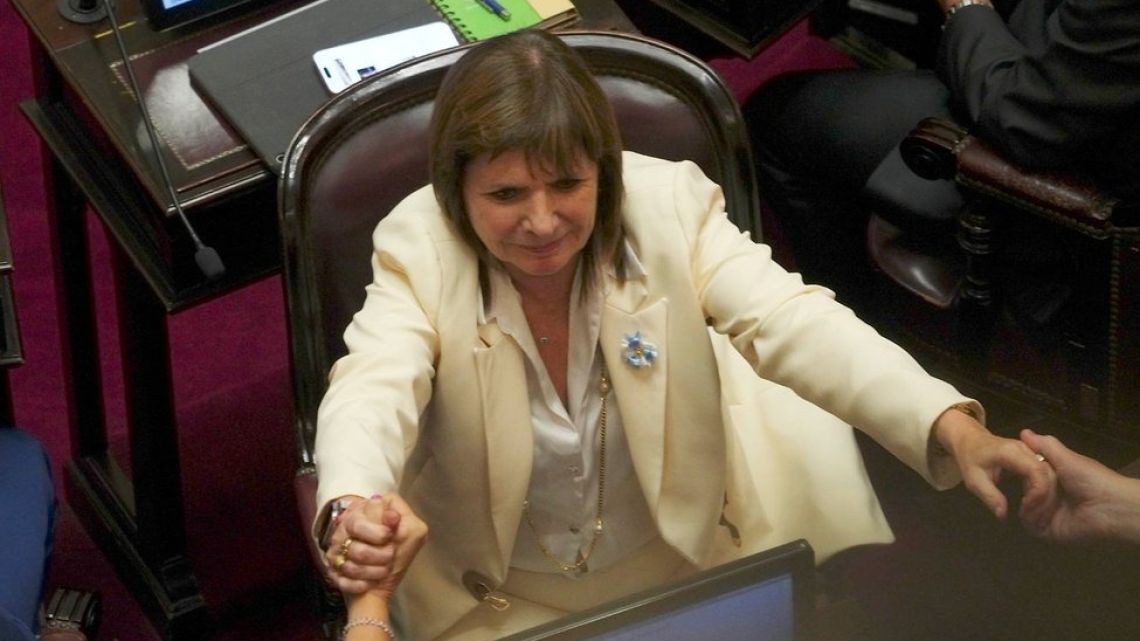
President Javier Milei has secured another legislative victory after the Senate voted to approve a new juvenile penal regime that will lower the age of criminal responsibility from 16 to 14.
The new regime – which Milei’s government says is “an act of justice for society” and replaces a system in place since 1980 – passed the upper house with 44 in favour and 27 against. It had already cleared the lower house Chamber of Deputies.
“Whoever has the capacity to understand the seriousness of their actions must, without exception, assume responsibility before the law. Adult crime, adult sentence,” Milei’s office said in a statement posted on the X social media platform minutes after the vote.
President Milei will sign the bill into law imminently.

Up until now, Argentina had one of the highest ages of criminal responsibility in South America. Bolivia, Chile, Colombia, Paraguay, Peru, Venezuela and the Dominican Republic set the age of criminal responsibility at 14. Brazil, Ecuador, Costa Rica, El Salvador and Panama have the lowest threshold in the region, set at 12.
In both cases, the treatment of children and adolescents who commit offences is based on socio-educational measures that prioritise their reintegration into society.
Under international standards, the minimum age of criminal responsibility is defined as the age below which a minor cannot be held criminally liable for their actions and therefore cannot be tried in court.

The government originally sought to lower the age to 13, but negotiated an upper limit to ensure consensus.
“We are here to put an end to a terribly dangerous doctrine – the doctrine that the criminal is a victim of the system,” said Senator Patricia Bullrich, the bill’s leading sponsor, during debate.
Bullrich, who has twice served as national security minister, has long pushed for a lowering of the threshold. She requested a minute’s silence for the victims of youth violence during the session.

Opposition lawmakers complained that the ruling coalition fast-tracked the committee stage despite the fact that most of the experts invited to speak had voiced opposition. They also warned that the timeframes for adapting detention facilities, as well as the allocated budget, would be insufficient.
“We want a state that provides a comprehensive response, one that includes education and resocialisation,” said Unión por la Patria Senator Martín Soria, from the Peronist opposition.
“On the other side, the only response is punitive,” he added.

The debate comes at a moment of heightened public sensitivity over crimes committed by teenagers that have attracted intense media coverage.
Government officials argue that violent crimes committed by minors aged between 12 and 15 have increased. Lawmakers in Milei’s party say that criminal gangs use minors to carry out offences because they know they “cannot be prosecuted.” The bill is intended to counter that strategy.
The passage of the new law is another boost for Milei, who has secured approval for several flagship proposals. The Senate is expected to give the greenlight to his controversial labour reform bill later today.
– TIMES/AFP/NA












Comments